

Every article about salon no-shows ends the same way: "consider requiring deposits." Thanks. The questions that actually keep salon owners from doing it — how much? for which services? what do I say to a regular of six years? will I lose bookings? — go unanswered, which is why most salons that "have a deposit policy" have it written in an Instagram bio and enforce it never.
This is the operator's version: the numbers, the per-service logic, the rollout script, and — since deposits only work when the booking system enforces them automatically — what salon software that takes deposits actually has to do. Disclosure before we start: we make booking software (VoltsBook), it appears in the options section near the end alongside its competitors, and everything before that section is true whichever system you use.
The math that makes this worth your time
Industry numbers from BookrHub's 2026 salon and barbershop no-show report: salons without a deposit system run a 15–25% no-show rate — hair salons at 15–20%, nail salons at 20–25%. With deposits collected at booking, those rates drop to 3–6%, a 60–80% reduction. The same report puts the average loss at $150 per missed appointment for a mid-range salon, compounding to $1,500–$3,000 a month. Run your own chairs through our no-show cost calculator to see your number.
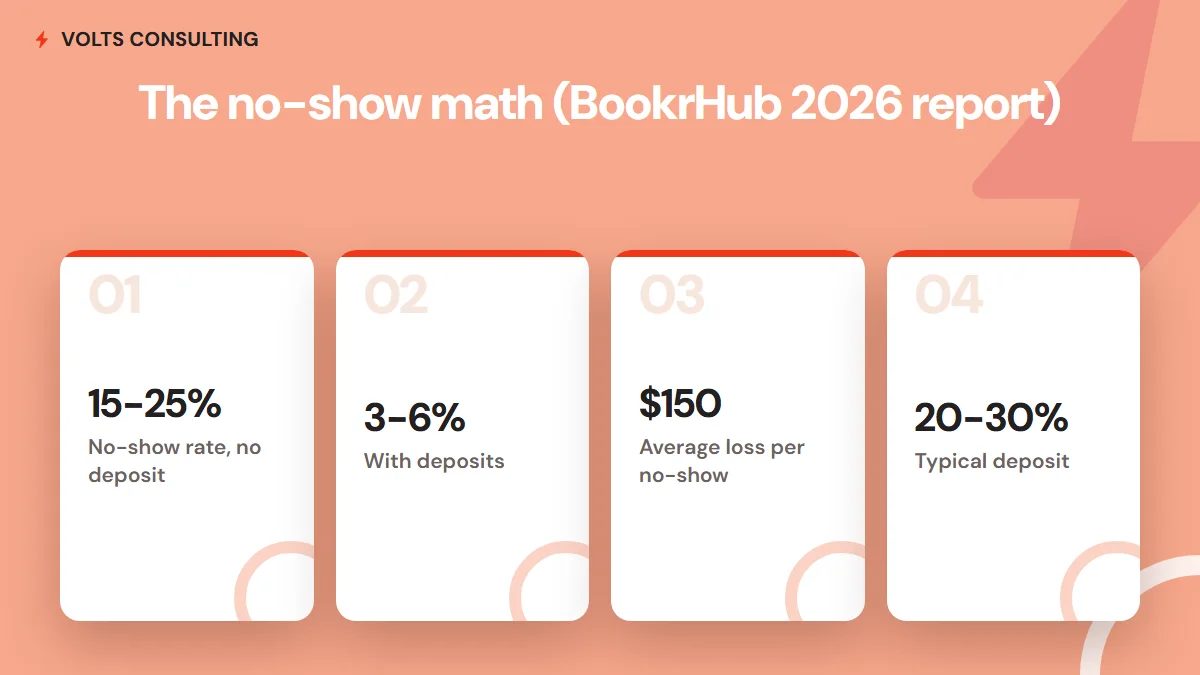
Two more numbers explain why deposits work so well. 68% of no-shows happen within 24 hours of the appointment — too late to refill the slot — and 23% of clients admit to no-showing at least once in the past year. A reminder text helps the client who forgot. Only money on the line changes the behavior of the client who half-meant it when they booked. That's the whole mechanism: a deposit converts "I'll probably make it" into a decision made at booking time, when the slot can still go to someone else. (Deposits are #1 in our cross-industry ranking of every no-show fix — the rest of the toolkit is there.)
How much to charge, service by service
The industry norm is 20–30% of the service price, but a flat percentage across your whole menu is the lazy version. The deposit should scale with what a no-show actually costs you — time blocked, product mixed, and how hard the slot is to refill:
| Service type | What a no-show costs you | Deposit that fits |
|---|---|---|
| Quick trim, blowout (under 45 min) | One short slot, easily refilled | Card on file or a small fixed $10–15 |
| Cut and style, standard color | An hour or two of chair time | 20–25% |
| Full color, balayage, corrections (2–4 hrs) | Half a day, product, prep | 30%, or a fixed $50+ |
| Extensions, bridal, group bookings | The day, often ordered stock | 50% — or full prepay for bridal |
Fixed or percentage? Percentage feels fairer across a varied menu and scales automatically when prices change. Fixed amounts are easier to say out loud ("there's a $25 booking deposit") and easier for clients to reason about. A workable compromise most salons land on: fixed deposits on the short stuff, percentages from standard color upward. Whatever you choose, the deposit should always come off the final bill — it's a commitment, not a fee, and saying that sentence out loud is what makes clients accept it.
Card-on-file is the halfway house. Holding a card and charging a no-show fee after the fact is better than nothing, but it's a worse version of the same idea: you're now in the business of charging penalties — disputes, awkward calls, chargebacks — instead of holding money the client already committed. Deposits move the friction to booking time, where it filters instead of punishes.
Rolling it out without burning your book
The fear is always the same: "my regulars will be offended." Here's the rollout that avoids finding out:
- New clients first, immediately. New bookings are where most no-shows live, and a new client has no old policy to compare against. Turn deposits on for them today; nobody will blink, because every salon they've tried lately asks.
- Announce before you enforce. Give existing clients 3–4 weeks of notice — a line in confirmation messages, a small sign at the desk, one social post. Frame it as protecting appointment availability, not punishing anyone.
- Word it once, properly. Steal this: "A [20%] booking deposit now confirms all appointments — it comes straight off your bill on the day. Life happens: rebook up to [24 hours] ahead and your deposit moves with you." The rebooking clause is the trust-builder; a deposit that transfers is a commitment, a deposit you lose to a sick child is a grudge.
- Grandfather with judgment, not policy. The regular of six years who has never missed? Quietly skip her — your software should allow per-client exceptions. The "regular" who no-shows twice a year is exactly who the policy is for, familiarity notwithstanding.
When someone pushes back, the script is two sentences: "It comes off your total on the day — it just holds the chair for you. If plans change, give me a day's notice and it moves to your new time." Delivered warmly, this loses almost nobody worth keeping. The client who refuses to commit $20 to a $120 appointment was telling you something about the appointment.

The honest trade-offs
Deposits are not free money, and anyone selling them as frictionless is selling something:
- You will lose some marginal bookings. A prepayment step filters impulse bookers — that's the point — but a few of those would have shown up. For most salons the math is heavily positive (an 80% no-show reduction against a small conversion dip); for a walk-in-heavy, low-ticket shop it may not be. Barbershops running $25 cuts on volume often do better with reminders and a walk-in culture than with deposit friction.
- Refund mechanics are real work if the software is bad. Cancellations inside policy need the deposit returned or credited without you doing manual card refunds at the desk. This is a software problem — see the checklist below — but it's your problem if you pick wrong.
- Deposits don't fix chronic overbooking or 45-minute-late running. Clients tolerate deposits from salons that respect time in both directions.
What the software actually has to do
"Takes deposits" appears on every booking tool's feature list. The version that works unattended has six specific behaviors — this is the checklist to take into any trial:
- Per-service deposit rules — fixed or percentage, set differently for a trim and a balayage, not one global switch.
- Money collected at booking, not promised — the card is charged (or the payment authorized) before the slot confirms. A "deposit" the client can skip is a suggestion.
- Balance tied to the appointment — the day-of bill already knows $30 was paid. If your front desk does that subtraction by hand, the system doesn't really do deposits.
- Policy-aware rebooking and refunds — cancel outside the window, deposit auto-returns or credits; inside it, it's retained. No manual refund runs.
- A reminder ladder on top — since 68% of no-shows brew inside the final 24 hours, deposits plus 24-hour and same-day reminders (email, SMS, WhatsApp) is the combination that gets salons to the 3–5% floor; BookrHub attributes an extra 20–30% reduction to the reminders themselves.
- No commission on your takings — the deposit is your money. Software that skims a percentage of what flows through it charges you most in your best months.
The options, including ours
Quick, fair sketches — verify current pricing yourself, it moves:
- Fresha — the marketplace giant; deposit and no-show protection features on a commission-flavored model tied to its booking marketplace. Strong if you want marketplace discovery; understand exactly what you pay per transaction before committing.
- Vagaro — mature, salon-native, solid deposit and cancellation-policy features; SMS packages and add-ons are where the base price grows.
- SimplyBook.me — flexible general booking system with genuine deposit support; salon-specific behavior takes more configuration since it serves every industry.
- Square Appointments — the low-friction default if you already run Square hardware; deposit logic is workable but basic, and we've written an honest comparison of where it stops.
- VoltsBook — ours. Built around exactly the checklist above, because deposits-per-service is the flagship feature: fixed or percentage per service, balance tracked to the appointment, policy-aware refunds, reminders on email, SMS and WhatsApp, and no commission ever — you pay your gateway's rate and nothing to us on your takings. Free plan takes real bookings; paid plans from $12/mo. Salons and barbers are among the nine trades it configures on day one. Where it stops: no marketplace to be discovered in (that's Fresha's genuine edge) and no built-in POS hardware line (that's Square's).
FAQ
Will I lose clients if I start requiring deposits? You'll lose some bookings — mostly the ones that wouldn't have shown. Salons in BookrHub's data see no-shows fall 60–80% after deposits; 80% of businesses see the improvement within 30 days. Roll out new-clients-first with the transferable-deposit wording and keep discretion for proven regulars, and the client-relationship cost rounds to zero.
How much deposit should a salon charge? 20–30% of the service price is the norm. Scale it: small fixed amounts (or card on file) for sub-45-minute services, 20–25% for standard work, 30% for long color and corrections, 50%-to-full for bridal and groups. Always credit it against the final bill.
Are booking deposits legal? Generally yes in the US as a standard commercial term, provided the policy is disclosed clearly before booking — which is another reason it belongs in the booking flow itself, not an Instagram bio. Rules on retaining deposits vary by state and country, so keep the policy written, visible and consistently applied, and check local consumer rules if you retain large amounts.
Deposit or cancellation fee — which works better? Deposits. A cancellation fee is money you have to take after the fact (disputes, chargebacks, awkwardness); a deposit is money the client already committed that you simply keep or credit. Prevention beats collection.
What about clients who don't have cards or won't pay online? Keep a manual override — take a deposit in person or waive it case by case. The system should make deposits the default path, not an iron gate. If a large share of your clientele is cash-only walk-ins, deposits may simply be the wrong tool for your shop, and that's fine.
If your books are leaking $1,500 a month to empty chairs, the fix is a policy plus software that enforces it while you're doing hair. VoltsBook's free plan takes real bookings with real deposits — set your per-service amounts in an afternoon and find out what a 4% no-show rate feels like. We also covered the full VoltsBook relaunch — what it does beyond deposits — if you want the whole picture first.