

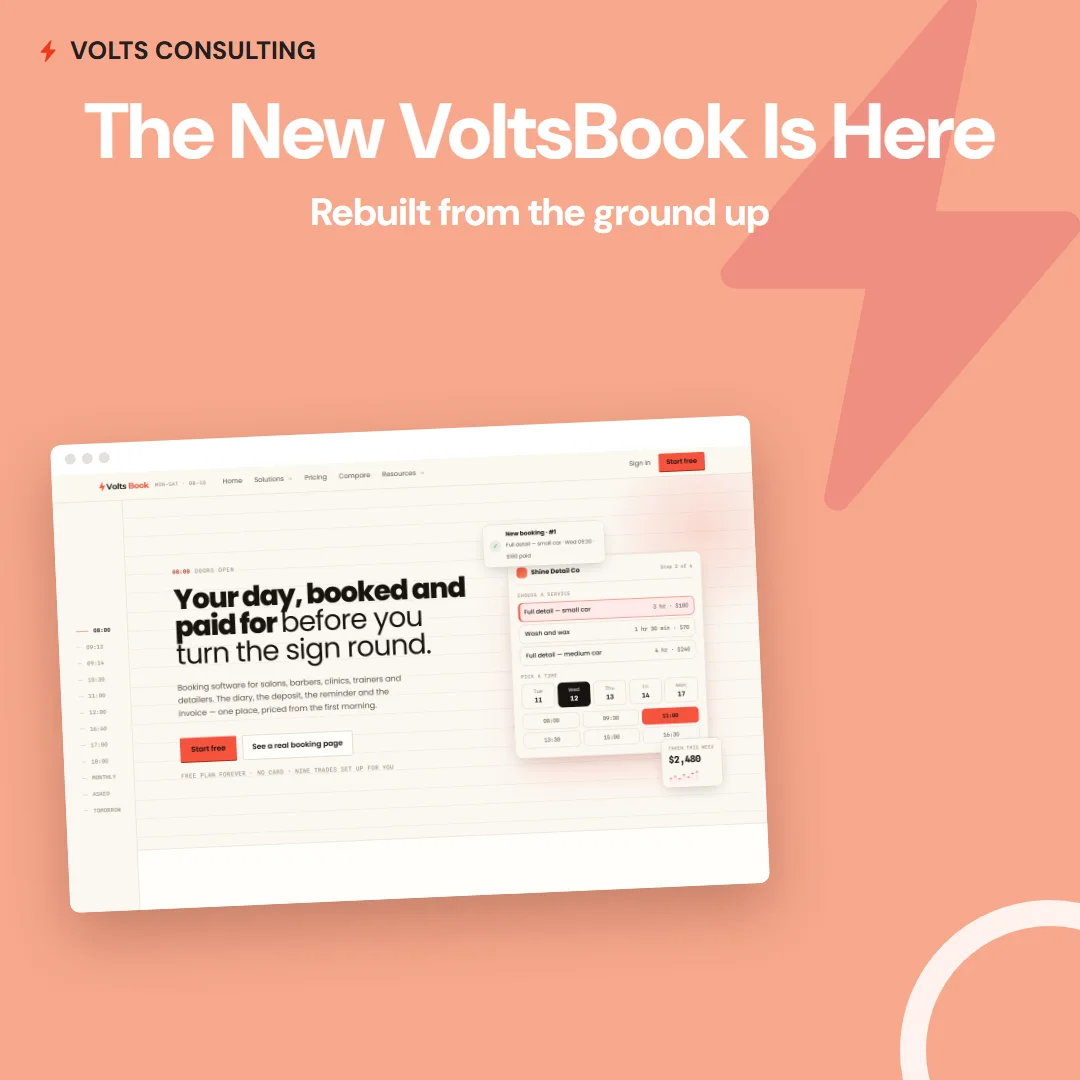
Two years ago we built VoltsBook because our detailing and salon clients kept asking the same question: why does simple appointment booking need five tools and a spreadsheet? Today we're announcing the answer's second act: VoltsBook has been completely rebuilt from the ground up — new engine, new booking experience, and a feature set that competes directly with the big scheduling names while staying built for the businesses the big names forget: the shops, salons, clinics, and studios where money changes hands at the appointment.
Here's what's new, what it means for your business, and where the honest limits are. (The short version lives on the new VoltsBook page; the product itself is at voltsbook.com with a free plan and no card required.)
Why rebuild instead of patch?
Because the first version taught us what booking software for service businesses actually has to be. Scheduling links solved "pick a time." They never solved the shop floor: the no-show who cost you a full slot, the deposit you had no way to hold, the three staff sharing two chairs, the day's takings scattered across a card machine and a cash tin. Patching those into the old foundation would have produced exactly the kind of bolted-together tool we built VoltsBook to escape — so we rebuilt the foundation instead. Clean room, new architecture, every feature rethought.
What's new in the rebuilt VoltsBook
Deposits that stop no-shows. Ask for a deposit per service — fixed or percentage — with the balance tracked to the appointment. Customers can pay the deposit or choose to pay in full; refunds handle themselves properly, right down to clawing back staff commission proportionally. (For the operator's side — how much to charge and how to roll a deposit policy out — see our salon deposits playbook.)
A diary built for teams. Every staff member has their own hours, services, breaks, holidays, and days off. Buffers hold cleanup time after the right services, group sessions track capacity, and double-booking is prevented at the database level — two customers racing for the last Saturday slot is decided by engineering, not apology.
The reminder ladder. Confirmation, 24-hour, 6-hour and 1-hour reminders, reschedule and cancellation notices, and the after-visit follow-up — twenty messages pre-written, delivered by email, SMS, or WhatsApp, in the language the customer booked in. Six languages, right-to-left included.

Waiting lists that refill cancellations. A full day stays full: when a booking cancels, the earliest customer in the queue gets a booking link automatically. The gap refills before it costs you money.
Money that adds up to one number. Stripe, PayPal, and Square side by side for online payments — plus cash, card machine, bank transfer, and cheque recorded at the counter. Gift cards with real balances, prepaid packages that count sessions down as they're used, loyalty points on spend, PDF invoices generated straight from the appointment. The day's takings become one number, however the money arrived.
A website included. Every account gets a hosted booking page for social and QR links, and an embeddable widget that drops into any existing site — WordPress, Squarespace, Wix, or hand-written HTML — with one script tag.
Nine trades, set up on day one. Barbers, hair salons, beauty and nails, massage and spa, clinics and therapists, personal trainers, tutors and consultants, pet grooming, and auto detailing all start with real services, durations, and prices already loaded. Ten minutes from signup to taking bookings is a genuine number, not a marketing one.
And for the technically inclined: two-way Google and Outlook calendar sync per staff member, Zoom and Google Meet links for meeting-based services, custom intake forms with conditional logic, arrival check-in with signatures and photos, and a public REST API with slot holds — built so AI voice and chat agents can book real appointments safely.
How does it stack up against Calendly and Cal.com?
Honestly — because that's the only comparison worth publishing. If you're one person booking meetings and money never changes hands at the appointment, Calendly is the best tool for that job and you should use it. Cal.com is open source and self-hostable, which VoltsBook is not.
VoltsBook wins where the appointment involves a price list: deposits held against running balances, part payments, a course of six counted down as it's used, stock decremented by the quantity sold, invoices numbered in sequence, commissions settled per staff member. Scheduling tools book meetings; VoltsBook runs the day. The full comparison — including what we concede — is on the product page.

What "rebuilt properly" means under the hood
Most software announcements skip this part; for us it's the point. The rebuilt VoltsBook treats correctness as a feature you can name:
- The last-slot problem is solved in the database. When two customers grab the final Saturday slot at the same moment, a database-level exclusion constraint decides it — one booking wins, the other instantly sees the truth. "Offered means available" is the product's central promise, and the availability engine behind it is property-tested against thousands of generated schedules, daylight-saving shifts included.
- The booking widget can't break your website. It's isolated in an iframe by design, so your site's styles can't break the widget and the widget's can't leak into your pages — and it ships under a 120-kilobyte budget that our own build system refuses to exceed.
- Plan limits play fair. Hitting a cap stops new creates; it never deactivates anything that already exists. A lapsed trial drops you to the free plan with your booking page still live — software that takes a working business offline to force an upgrade is exactly what we didn't build.
- Every promise has a test. The engineering guarantees behind VoltsBook are written down and each one maps to automated checks — a guarantee nobody is verifying is just marketing, and we treat it that way.
None of this shows up in a screenshot, which is why we're writing it down. It's also, frankly, the portfolio: the discipline VoltsBook is built with is the discipline our client work gets.
What does it cost?
Free forever, genuinely. The free plan takes real bookings with a real calendar and customer records, doesn't expire into a bill, and won't have features quietly moved out of it later. Paid plans are $12 (Solo), $29 (Professional), and $79 (Business) per month, with annual billing working out at ten months for twelve. Every account starts with a 14-day trial of everything — no card — and when the trial ends you drop to the free plan and keep trading; a lapsed trial never takes a working booking page offline.
One more thing worth saying plainly: there's no fee on your takings. You pay your payment gateway's standard rate — VoltsBook never takes a percentage of what your customers spend.
Already running on something else?
Switching booking tools usually means abandoning your history, which is why nobody does it. VoltsBook ships with a real import path: full appointment history from Booknetic and from older VoltsBook installs comes across with original booking numbers preserved, so your records — who came, when, how often — survive the move intact. Set up your services from the starter kit, import the past, and the switch happens between one working day and the next rather than as a painful clean break.
Why this matters beyond VoltsBook
VoltsBook is a product we run, but it's also the standard we build to — the same team, the same engineering discipline, that builds web apps for clients. When we write on this site about what software should cost or how service businesses win online, VoltsBook is where we test those opinions against reality first.
If you run a bookings-based business, start free at voltsbook.com — ten minutes from now, your trade's price list is loaded and your booking link works. If you want the full tour first, the VoltsBook page walks through everything with the details visible.
Frequently asked questions
I used the old VoltsBook — what happens to my account? The rebuilt platform can import your history — appointments and booking numbers carry over, so your records don't reset. Reach out through your account or contact us and we'll walk you through the move.
Do my customers need an app? No. They book from a link, pay a deposit if you ask for one, and get confirmations and reminders by email, SMS, or WhatsApp. No downloads, no accounts required for them.
Can it replace my current scheduling tool? If your appointments involve staff, services, and payment, that's exactly what it's built for — and imports from Booknetic and older VoltsBook installs preserve your history. If you just book meetings with no money involved, a scheduling link may honestly be all you need.
Is my industry supported? Nine trades come pre-configured, and everything is adjustable — if yours isn't listed, start from the closest kit and rename what you need. The free plan makes trying it a zero-risk exercise.