

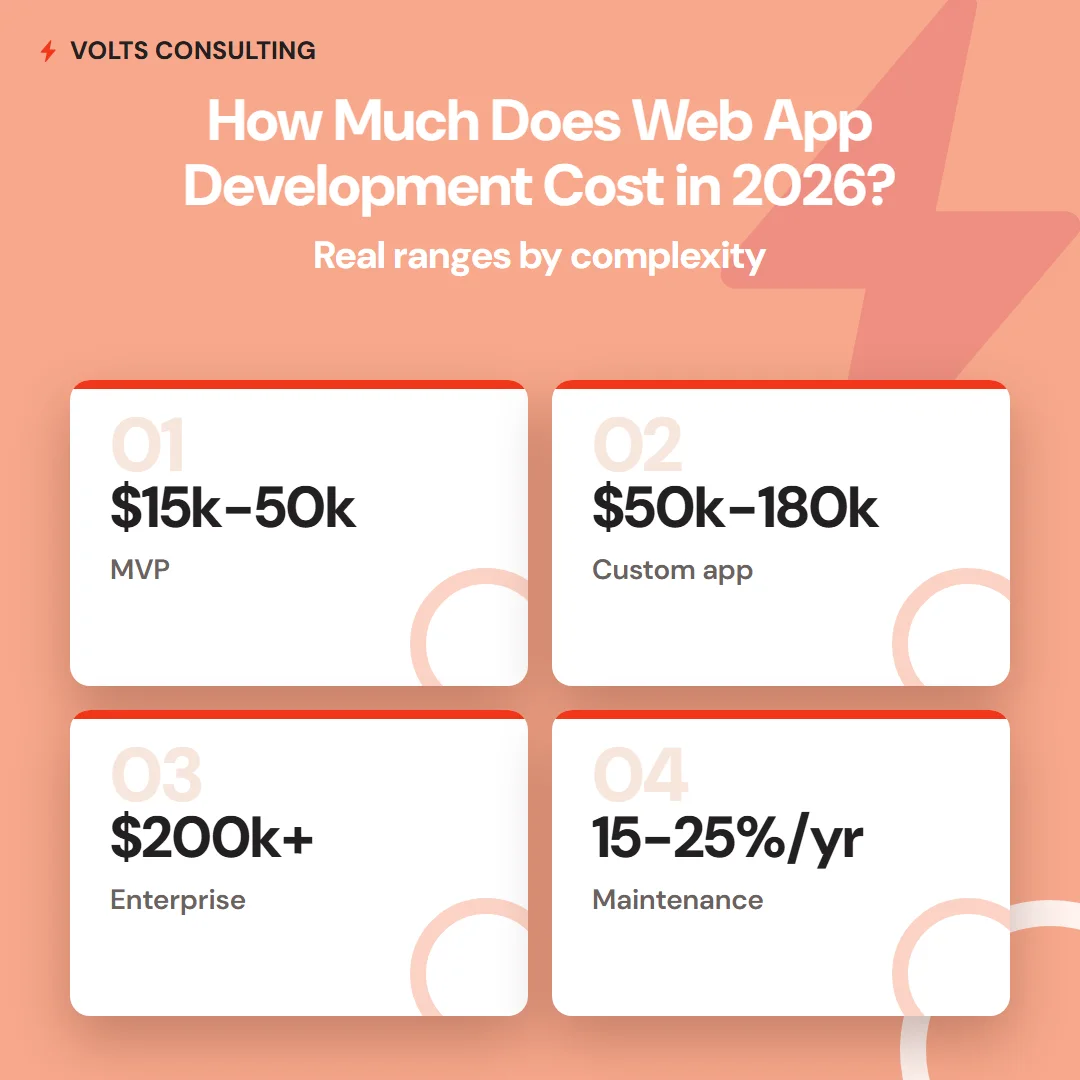
Web app development cost in 2026 spans a famously unhelpful range: roughly $15,000 – $50,000 for a focused MVP, $50,000 – $180,000 for a custom business application, and $200,000+ for complex platforms — with template-based validation builds under that and enterprise systems far above it. The spread isn't agencies being coy; it's that "web app" describes everything from a booking tool to a multi-tenant SaaS. We build across that whole range in our web app development practice, so here's the honest breakdown of where your project actually lands — and why.
One framing note before the numbers: this post prices genuine web applications — software users sign in to and operate. If you're not sure that's what you need, start with web app vs website; the answer changes the budget by an order of magnitude.
What does web app development cost in 2026?
We cross-checked the current pricing guides from five development firms while researching this post, and the tiers converge more than the headline ranges suggest:
| Tier | Typical 2026 cost | Timeline | What it really is |
|---|---|---|---|
| Template-based validation build | $5,000 – $15,000 | 2–6 weeks | Proving an idea with off-the-shelf parts, not custom software |
| MVP / focused first version | $15,000 – $50,000 | 1–3 months | One core workflow done properly: accounts, data, the feature that matters |
| Custom business app / early SaaS | $50,000 – $180,000 | 3–6 months | Roles, dashboards, payments, integrations — software a business runs on |
| Complex platform | $200,000 – $500,000+ | 6–15 months | Marketplaces, multi-tenant SaaS, high-load or regulated systems |
The most consistent number across every source wasn't a build price at all: annual maintenance converges on 15 – 25% of the initial build cost, per year — the most agreed-upon figure in web app pricing. Keep it in view from day one; more on it below.
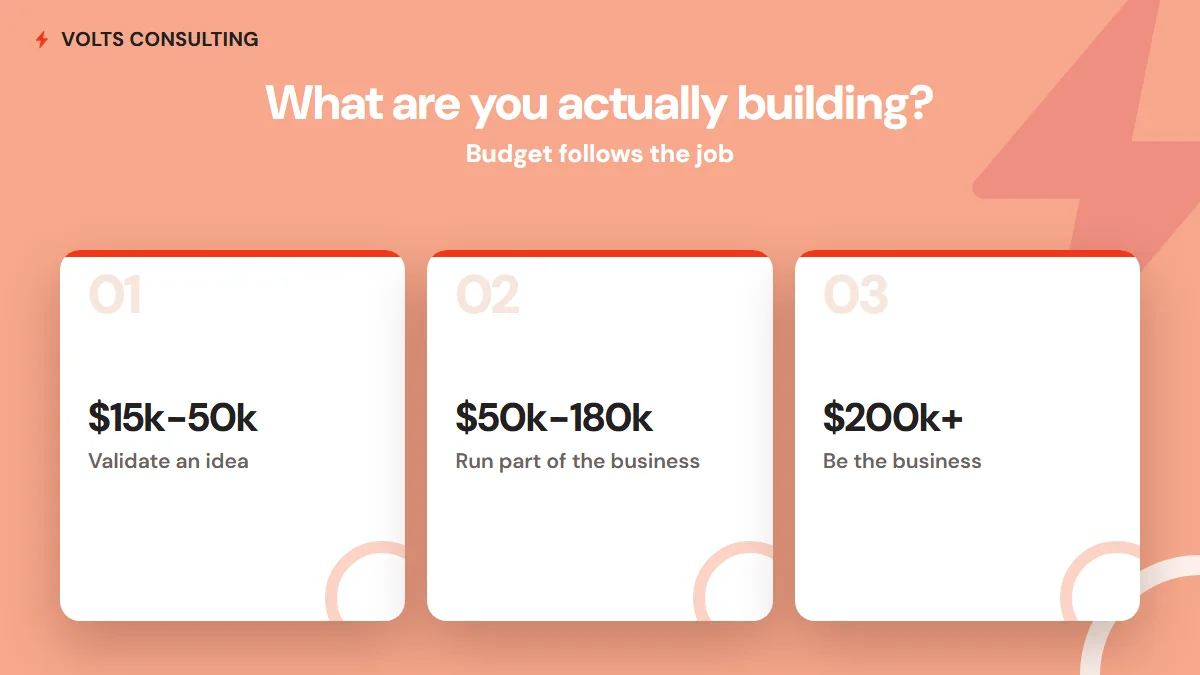
A cleaner way to pick your tier than counting features: ask what the app is for. Validating an idea → bottom tier. Running part of the business → middle. Being the business — the thing customers pay for — top tier. Budget follows the job.
How much does each feature add?
Estimates get real when they're itemized. These are representative engineering ranges (hours × a blended $75 – $125/hr team rate) for common building blocks:
| Feature | Typical hours | Typical cost |
|---|---|---|
| Authentication & user accounts | 20 – 40 | $1,500 – $5,000 |
| Admin panel / dashboard | 60 – 120 | $4,500 – $15,000 |
| Payments & subscriptions | 40 – 80 | $3,000 – $10,000 |
| Third-party API integrations | 20 – 60 each | $1,500 – $7,500 each |
| Search & filtering | 30 – 80 | $2,000 – $10,000 |
| Messaging / real-time features | 100 – 160 | $7,500 – $20,000 |
| Roles & permissions | 40 – 90 | $3,000 – $11,000 |
| Reporting & analytics | 50 – 120 | $4,000 – $15,000 |
Two things this table teaches: features that look small (chat, notifications) are often the most expensive, and every integration is its own little project. When someone quotes a marketplace "with messaging, reviews, and payments" for $10,000, this table is why you should ask what's been left out.
What drives the price up or down?
- Team composition. A real build involves design, engineering, QA, and coordination — not one heroic developer. More specialized roles, more cost, usually less rework.
- Design depth. Wireframes-to-templates is cheap; researched UX with custom UI is not. The difference shows up in whether users need training.
- Integrations and data migration. Clean-slate apps are predictable; syncing with a legacy CRM or importing ten years of spreadsheets is where estimates wobble.
- Security and compliance. Handling payments, health data, or minors' data adds audit, infrastructure, and process cost that no honest quote can skip.
- Scale requirements. Software for 50 staff and software for 50,000 customers differ in architecture, not just hosting.

What do developer rates look like in 2026?
Hourly rates, not project tiers, are where geography shows up:
| Region | Typical senior rate |
|---|---|
| North America | $100 – $250/hr |
| Western Europe | $70 – $160/hr |
| Eastern Europe | $40 – $110/hr |
| India & Asia-Pacific | $20 – $80/hr |
The arbitrage is real but not free: the cheapest hour is rarely the cheapest project. Managing an offshore team is a skill, and rework from communication gaps eats rate savings quickly. We serve both the US and India, and our honest advice is to compare outcomes per dollar — shipped features, performance, maintainability — rather than rates. A $40/hr team that needs three attempts costs more than a $100/hr team that needs one.
Is AI-assisted development making apps cheaper?
At the low end, dramatically — and it's the biggest change in 2026 pricing. AI coding tools and app builders have compressed the cost of prototypes and simple internal tools: what took a junior team a month can now take a senior developer days. If your goal is validating an idea, this is genuinely good news, and it's reflected in the bottom tier above.
What AI hasn't compressed: integration work against messy real-world systems, security and compliance, performance at scale, and the judgment involved in deciding what to build. Mid-tier and complex builds still cost what senior attention costs — the tools make good teams faster, they don't make hard problems easy. Treat any quote claiming "AI lets us build your SaaS for $5,000" the way you'd treat any price that's 90% below market.
What are the hidden and ongoing costs?
The build price is the entry fee, not the total. A realistic 3-year picture for a $60,000 app:
- Maintenance and evolution: 15 – 25% of build cost per year — $9,000 – $15,000/yr for updates, fixes, dependency and security patches, and the small features users request the week after launch.
- Infrastructure: hosting, databases, monitoring — anywhere from $50/month for a lean app to $1,000+/month at scale.
- Third-party services: payment processing fees, email/SMS delivery, maps, search — individually small, collectively a real line item.
- Security and compliance upkeep: certificates, audits, dependency updates; more if you're in a regulated space.
Rule of thumb worth writing down: plan for the 3-year total cost of ownership to be roughly 1.5× the build price. If the launch budget only just covers the build, the budget is wrong.
How do you keep the budget sane?
- Scope the first version around one workflow. The discipline isn't building less forever — it's learning from real users before funding the roadmap. Our step-by-step app guide walks through this scoping process.
- Get estimates itemized. A single number hides assumptions; a feature-by-feature estimate surfaces them. This is how we quote: after scoping, you get a fixed, written, itemized quote — typically within 48 hours — that holds unless the scope changes.
- Fixed price for defined scope, time-and-materials for discovery. Fixed bids on vague scopes just price in the uncertainty; you pay for the risk either way, so define the scope first.
- Build on foundations that can grow. The same modern stack can carry a marketing site, then bookings, then a full portal — which is why websites can graduate into web apps without a rebuild if they're architected that way from the start.
If you're weighing a specific idea, book a free strategy call — we'll scope it with you, tell you which tier it honestly belongs in, and give you a real number instead of a range.
Frequently asked questions
What's the cheapest legitimate way to validate an app idea? A template-based or AI-assisted prototype in the $5,000 – $15,000 range — enough to put a working version in front of real users. Spend serious money only after they've told you what matters.
How long does web app development take? 1–3 months for a focused MVP, 3–6 months for a custom business application, and 6–15+ months for complex platforms. Add time for discovery before development starts — skipping it is how projects overrun.
How much does web app maintenance cost? Budget 15 – 25% of the initial build cost per year. An app is a living system: dependencies age, browsers change, users request features, and security patches can't wait.
Does a web app cost more than a mobile app? Usually less for equivalent functionality, because one web codebase serves every device while native iOS + Android means two. Many businesses ship the web app first and add native apps only when the product demands device features.
Fixed price or time-and-materials — which is safer? Fixed price is safer for well-defined scopes; time-and-materials is more honest for exploratory work. The unsafe option is a fixed price on a fuzzy scope — someone is absorbing that risk, and it's priced in somewhere.
Building a customer-facing product is one job; building the internal systems that run your operation is another. If it's the second, that's custom software development — same team, different shape of problem.