

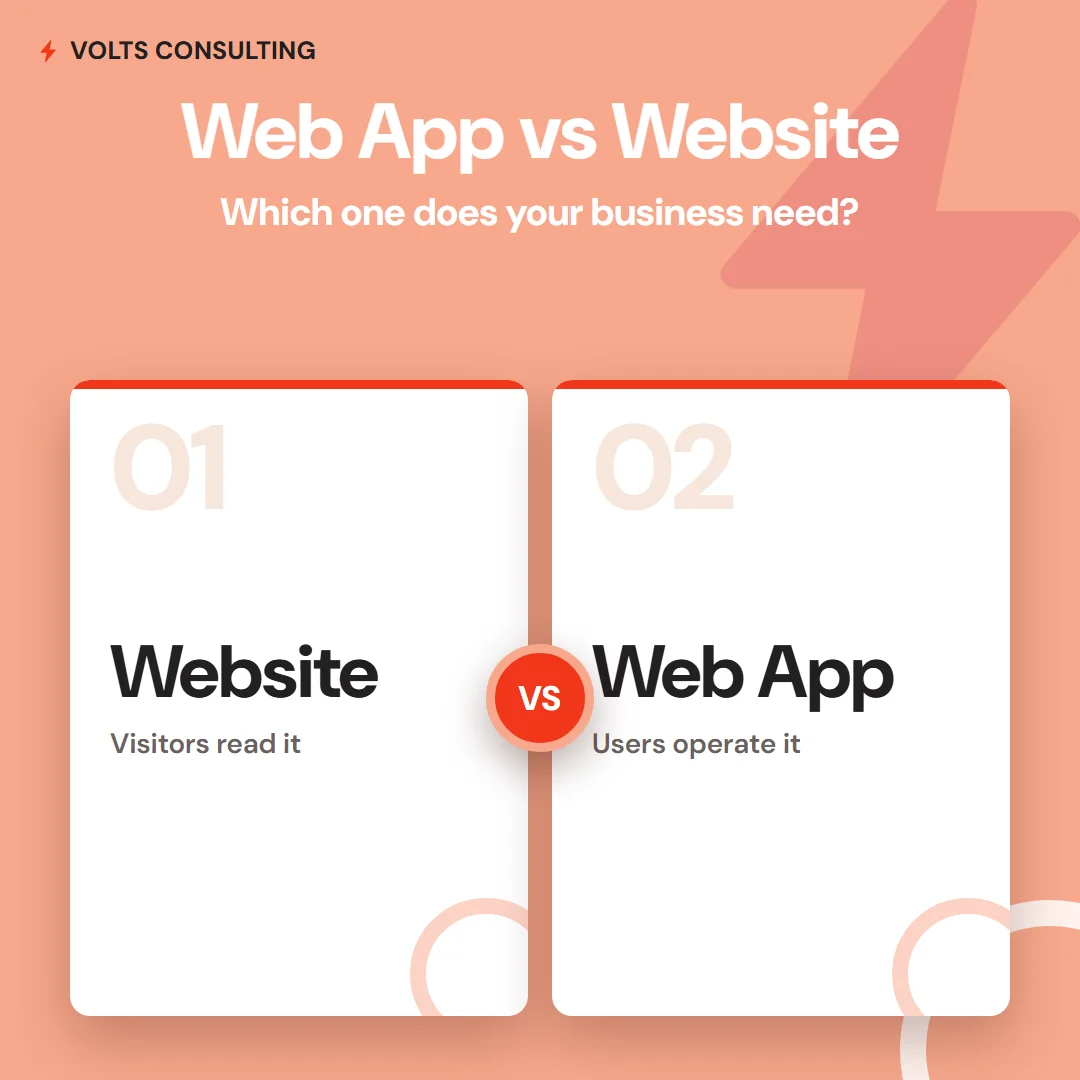
Every few weeks, a discovery call starts with "we need an app." Sometimes that's exactly right. Just as often, what the business actually needs is an excellent website — and the difference between those two answers is months of timeline and a very different budget. We build both custom websites and full web applications, so we have no reason to steer you either way. Here's the plain-English explanation we give on those calls.
What's the actual difference between a web app and a website?
Both live in a browser, both open from a link, and both can look identical from the outside. The difference is the direction the value flows.
A website is content you publish and visitors consume: they read about your business, look at your work, and take a simple action — call, book, enquire, buy. The site talks; the visitor decides.
A web app is software people operate: they sign in, create and change data, and get something done — manage shipments, track clients, run reports. The user works; the software works back.
| It's probably a… | Because it mainly… | Examples |
|---|---|---|
| Website | Presents and persuades | Company sites, portfolios, restaurant sites, landing pages, blogs |
| Website with app-like features | Persuades, then transacts | Online stores, booking pages, quote calculators |
| Web app | Gets operated by signed-in users | Client portals, SaaS products, dashboards, marketplaces, internal tools |
The simplest test we know: if your users never sign in, you probably don't need a web app yet.
Why does the distinction matter?
Because a web app is a software project and a website is a communication project, and they cost, take, and demand very different things. A website is measured in weeks; a serious web app is measured in months, needs engineering and testing rather than just design and content, and carries real ongoing costs — infrastructure, security, updates — for as long as it runs.
Getting it wrong is expensive in both directions. Overbuild, and you pay software-project money for accounts and dashboards your customers never asked to operate. Underbuild, and you end up bolting a dozen plugins onto a website until it becomes a slow, fragile imitation of the app you needed — then paying again to build it properly.
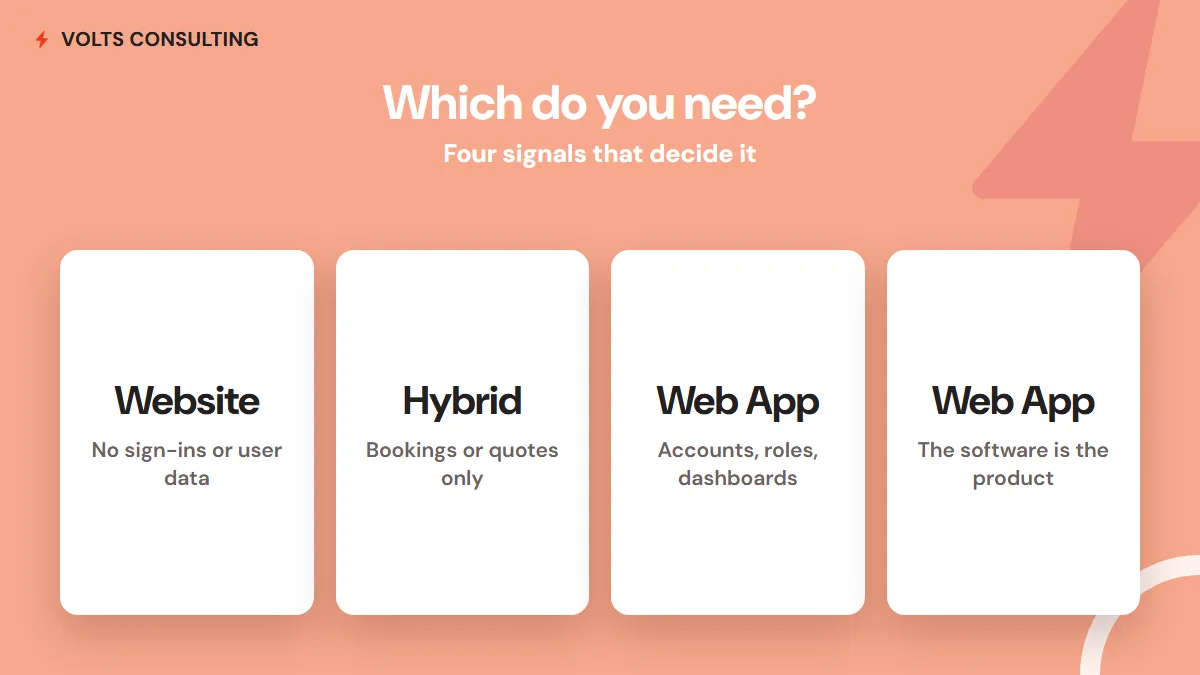
Which one does your business need? Four signals
Run your idea through these four questions:
- Do people need to sign in? If customers or staff need personal accounts — not just an email receipt, but a place they return to — you're describing an app.
- Does data flow both ways? Visitors reading your content is a website. Users creating, editing, and depending on their own data is an app.
- Are there roles and workflows? The moment "customers see this, staff see that, admins approve the other" enters the conversation, you're specifying software.
- Is the software itself the product? If the thing you're selling is the tool — subscriptions, seats, usage — that's a web app by definition.
Zero yeses: build a website, and make it excellent. One yes, and it's bookings or quotes: you likely need the hybrid below. Two or more: budget and plan for a genuine web app.
The middle path most businesses miss
Most businesses that think they need an app actually need a website with one app-like feature: online booking, a quote calculator, payments, gated content for clients. That single feature delivers most of the value of "an app" at a fraction of the cost — and it's the cheapest possible way to find out whether your customers even want more.
This is where a lot of our discovery calls land, and it's why we ask about your customers before we ask about features. The goal isn't the most impressive build; it's the shortest path to the outcome you're buying.

When do you genuinely need a web app?
When the signals stack. The RRGLS freight-intelligence platform in our portfolio is a clear example: multiple companies operating in one system, role-based access, live shipment data, dashboards and reporting. No website stretches to cover that — it's software, and pretending otherwise would have produced an expensive failure.
The pattern to notice: RRGLS didn't need an app because apps are impressive. It needed one because its users work inside it every day. That's the bar. (If you're in that industry, our logistics website design page covers what carriers and brokers specifically need — tracking portals included.)
Can a website grow into a web app later?
Yes — if it's architected with that in mind. Modern stacks share their foundations: the same technology that renders a fast marketing site can carry accounts, data, and dashboards when the time comes. That's how we build, and it means "start with a website, add the booking feature, graduate to a portal" is a genuine path rather than three rebuilds.
If you're at the earlier end of that path, start with custom website vs website builder to pick the right foundation — and when you're comparing partners for either kind of build, these twelve questions will tell you who can actually deliver.
Frequently asked questions
Is an online store a website or a web app? A hybrid. The storefront your customers see behaves like a website; the inventory, orders, and admin behind it are an app you typically rent from a platform rather than build. That's why e-commerce is usually scoped as a website project with platform integration, not custom software.
Is a PWA a website or a web app? A progressive web app is a delivery mechanism, not a category: it's a website or web app that installs and behaves like a native app on a phone. Decide what you're building first; decide whether it should be a PWA second.
Do web apps rank on Google like websites do? The parts behind a login don't rank — Google can't sign in. That's why every good web app still needs a public marketing site doing the SEO work. If organic search matters to your growth, you're building both, and the website half deserves real investment.
How long does each take? A custom website typically runs a few weeks from kickoff to launch. A web app is a phased software project — a focused first version usually takes a few months, and the roadmap continues after launch. Anyone quoting app-in-a-week or website-in-a-quarter deserves follow-up questions.
Not sure which one you're describing?
Bring the idea to a free strategy call. We'll run it through the four signals with you and tell you honestly which it is — including when the answer is "a website, and here's the one feature that gets you 90% of the way."