


Every web design agency's website says the same three things: award-winning, results-driven, trusted by clients. None of that tells you who will actually build your site well. After years of designing websites — and inheriting plenty of projects other agencies fumbled — we know exactly which questions separate the builders from the salesmen. Here are the twelve we'd ask if we were hiring.
Budget context first: if you haven't yet, read what website design costs in 2026, and make sure an agency is even the right vehicle versus a website builder. If you're comparing agencies right now, this list is your interview script.
Portfolio and proof — questions 1–4
1. Can I visit your portfolio sites live, today? Mockups on Dribbble and screenshots in a PDF aren't a portfolio — they're concept art. Ask for URLs, open them on your phone, and note whether the sites are fast, current, and still online. A dead portfolio link tells its own story.
2. Which of these did your current team actually build? Agencies acquire portfolios through mergers, white-label partners, and departed staff. "Show me something the people who'd work on MY project shipped in the last year" is a fair ask, and the hesitation before the answer is data.
3. Can I speak to two past clients? Not testimonial quotes — conversations. Five minutes with a past client answers what no proposal will: did they hit deadlines, how did they handle changes, what happened after launch?
4. What results did the work produce? Better-looking is not a result. Ask what changed: leads, bookings, load time, rankings. Agencies that measure will answer instantly; agencies that decorate will change the subject.
People and process — questions 5–8
5. Who exactly does the work? The person pitching you is often not the person building for you. Ask whether design and development happen in-house or get subcontracted — outsourcing isn't automatically bad, but not knowing who holds your project is.
6. What does your process look like, step by step? You're listening for a discovery phase before any design, defined review points, and a content plan. If the process starts at "we'll send you three homepage concepts," strategy isn't part of the service — you're buying decoration.
7. Who writes the content? The most common reason website projects stall is content nobody was assigned to produce. A serious agency raises this before you do.
8. What happens after launch? Sites need updates, backups, security patches, and someone to call when something breaks. Ask what support costs, what's included, and what response time looks like — maintenance is a real budget line, not a courtesy.
Money and ownership — questions 9–12
9. Will you publish or commit to a price range? Agencies guard prices because vague scope lets quotes grow. You don't need a number before a call — but an agency that won't even give ranges after understanding your project is planning to price you, not the work.
10. Who owns the code, content, and accounts? The correct answer is: you, all of it — code, content, domain, hosting, analytics. Proprietary builders and agency-held accounts are how a website becomes a hostage. Get ownership in the contract.
11. What's NOT included? Copywriting? Photography? Extra revision rounds? Integrations? The gap between a cheap quote and an honest one usually lives in this answer.
12. How will my site score on Core Web Vitals — and how does yours score? Google's speed metrics affect rankings and conversions, and they're publicly testable. Which brings us to the checks you can run without asking anyone anything.
What can you verify before any call?
Four checks, fifteen minutes, no meeting required:
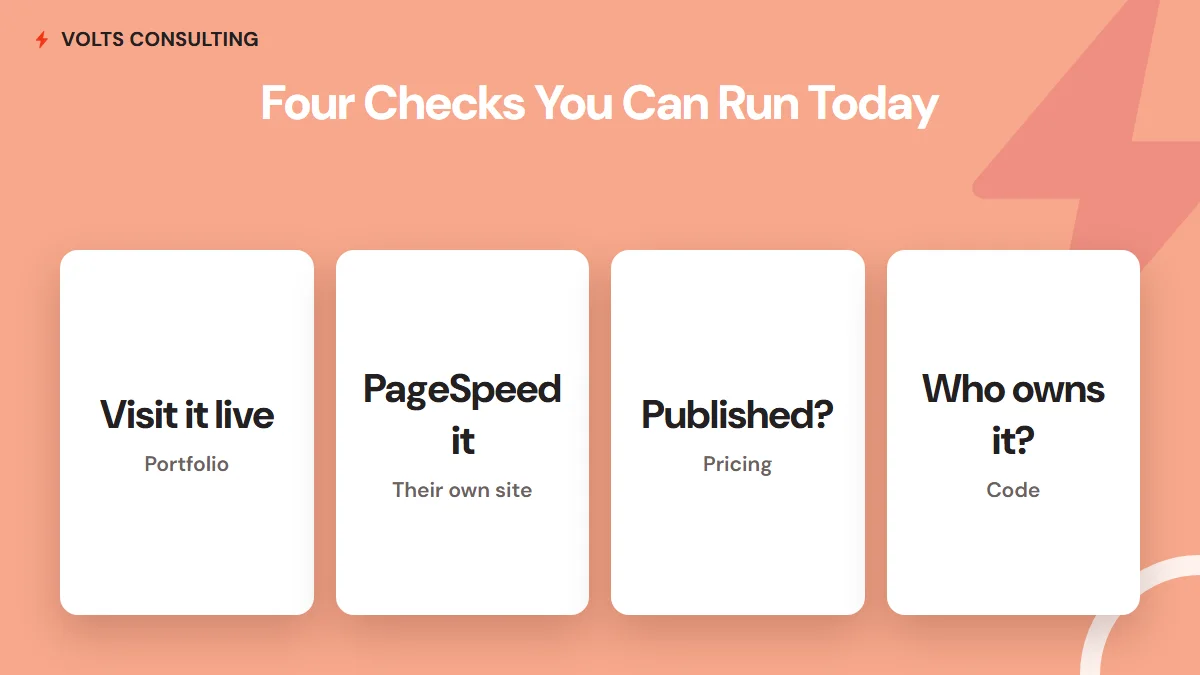
- Open their portfolio sites on your phone. Slow, broken, or dated live work is the truest review an agency can get.
- Run their own website through PageSpeed Insights. An agency's own site is its most honest portfolio piece. If they can't make their own site fast, yours won't be either.
- Ask how they quote before asking what it costs. An agency that scopes once and commits to a fixed written quote — the way we describe on our LA and Kuwait pages — is pricing the work. One that keeps the number vague until you're invested is pricing you. For what the market charges, our cost guide has real ranges.
- Search the agency's name plus "reviews" beyond their own testimonials page. Patterns across Google and Clutch reviews matter more than any single rave or rant.
Which red flags should end the conversation?
- "Unlimited revisions" or "unlimited pages" — unlimited anything means the unit of work has no defined value.
- A quote delivered before anyone asked about your customers or goals.
- No discovery phase, no content plan, no written scope.
- The contract is silent on who owns the code.
- Pressure to sign this week for a "discount that expires."
How would we like to be judged?
By the same standard as everyone on your shortlist: our portfolio is live and visitable, our quotes are fixed in writing, our process is written down, and you own everything we build. Run the four checks on us alongside anyone else — then book a free strategy call and ask us the other eight questions yourself.
Frequently asked questions
How many agencies should I shortlist? Three is plenty. More than that and you're comparing proposals instead of builders — and proposals are the least reliable evidence in the process.
Should I pick a local agency or work remotely? Pick the better builder. Website projects run fine over calls and WhatsApp; what matters is responsiveness, written scope, and proof of work — not office proximity. Local only wins when in-person workshops genuinely matter to you.
Is the cheapest quote ever the right choice? Occasionally — when the scope is genuinely tiny and honestly written. But quotes far below the pack usually omit the work that makes a website perform: strategy, content, speed engineering. The gap shows up later, priced as change orders.
How long should choosing take? Two weeks of real diligence beats two months of proposal ping-pong. Run the four checks, hold the three conversations, ask the twelve questions, decide.