

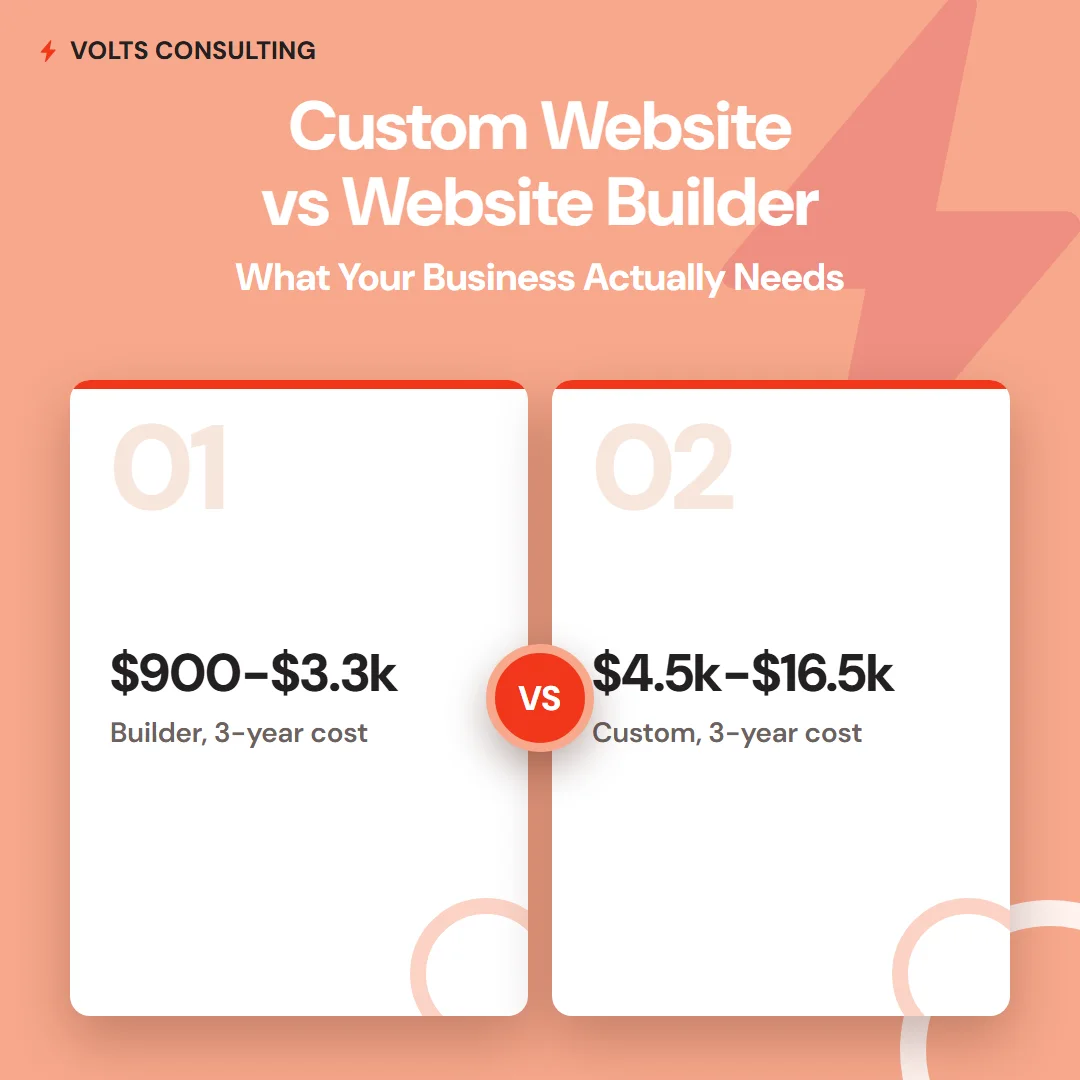
Here's an answer you won't hear from most agencies: sometimes the website builder is the right call. We design custom websites for a living, and we still tell some businesses on discovery calls to go set up a Squarespace site and call us in a year. The trick is knowing which side of that line you're on — because picking wrong in either direction costs real money.
This is the honest comparison: what each option actually costs over three years, where builders genuinely win, where they quietly cap your growth, and the signals that it's time to switch. If you're budgeting, read our full website design cost breakdown alongside this.
What's the real difference between a builder and a custom website?
A website builder (Wix, Squarespace, Shopify's themes, GoDaddy) rents you a page-assembly tool with hosting bundled in: you pick a template, fill in your content, and the platform handles everything technical. A custom website is designed and engineered for your business specifically — your brand, your customers, your conversion path — and you own every line of it.
The difference isn't "amateur vs professional." It's renting a standardized space vs owning a purpose-built one. Both can look good. Only one can be exactly what your business needs — and only one is yours.
When is a website builder genuinely the right call?
We recommend builders without hesitation when:
- You're validating an idea. A new business that might pivot in six months shouldn't spend five figures on a website. Get something live this week, learn, then invest.
- The budget is under ~$1,500. A cheap custom site is worse than a good template — if that's the budget, a well-executed builder site beats a cut-rate freelancer build almost every time.
- Your customers don't comparison-shop online. If work comes through referrals and the site just needs to exist and look credible, a builder clears that bar.
- You genuinely enjoy DIY and have the hours. Some owners like running their own site. The builders are built for exactly you.
No credibility play from us here: if this is you, take the builder, and spend the savings on Google Business Profile and reviews — they'll move the needle more.

What does each actually cost over 3 years?
The sticker prices mislead in both directions, so here's the fuller math:
| Cost over 3 years | Website builder | Custom website |
|---|---|---|
| Platform / build | $600 – $1,800 (subscriptions) | $4,000 – $15,000 (one-time) |
| Apps & plugins | $300 – $1,500 | usually included in build |
| Hosting & domain | included | $150 – $1,500 |
| Your time | 40 – 120+ hours (setup, upkeep, fighting the template) | near zero |
| Design refresh | often needed by year 2–3 | designed to last 4–6 years |
| Realistic 3-year total | $900 – $3,300 + your hours | $4,500 – $16,500 |
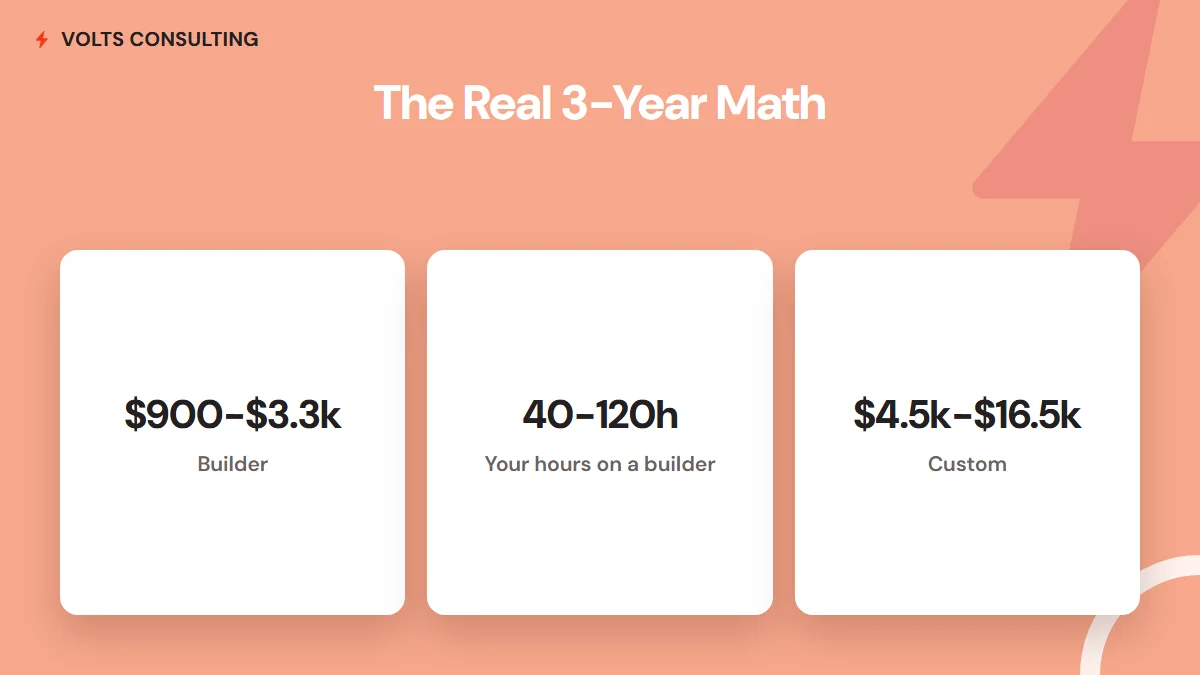
Two things the table can't show: what your hours are worth (40 hours from a founder billing $100/hr is $4,000 of invisible cost — most of the gap), and what the site earns. A custom site that converts even one extra client a month at a $2,000 average pays its entire three-year cost several times over. Builders optimize what a site costs; custom optimizes what it makes.
Where builders quietly cap you
The ceilings don't show up on day one — they show up when you start growing:
- The template look. Your site resembles thousands of others because it is thousands of others. When customers compare tabs, sameness reads as interchangeable.
- Performance you can't fix. Builder pages carry the platform's code weight. When Google's Core Web Vitals hold you back, there's no engineer to call — that's just what the platform serves.
- SEO within limits. Basics work fine; the sharp tools (structured data control, custom page architectures, programmatic landing pages) range from awkward to impossible.
- Lock-in. You can export your text and images. You cannot export the site. Leaving means rebuilding — which businesses discover at exactly the moment they've outgrown the platform.
- Integration walls. CRMs, booking flows, quoting tools, member areas: if the app store doesn't have it, you're not doing it.
What are the signals it's time to switch?
From the businesses that come to us mid-migration, the pattern is consistent:
- You've started avoiding your own website — it embarrasses you in sales conversations.
- Competitors with better sites outrank you for searches you should own.
- You need a workflow the platform can't do (real booking, quoting, portals, multi-location pages).
- You're paying for a stack of apps that half-work around the platform's limits.
- The business now earns enough that one lost customer costs more than a custom site's monthly amortized cost.
When you do switch, the migration matters as much as the build: your existing pages have search equity, and a proper rebuild preserves it with mapped 301 redirects — the step cheap migrations skip and pay for in vanished rankings. (We covered the warning signs in 6 signs it's time to redesign.)
How do you decide? Five questions
- Do customers compare you against competitors in a browser? If yes, design quality is revenue, not vanity.
- What's a new customer worth? Under $200, builders make sense longer; over $1,000, custom pays back fast.
- Is the website a brochure or a machine? Brochures tolerate builders; machines (booking, quoting, converting) don't.
- Who maintains it? Be honest about whether you'll actually do the upkeep.
- Where is the business in 18 months? Build for that, not for today.
If you land on custom — or you're not sure which side you're on — book a free strategy call. We'll tell you straight if a builder still serves you, exactly like we do on real discovery calls.
Frequently asked questions
Is Wix or Squarespace bad for SEO? Not inherently — the basics (titles, descriptions, clean pages) work. The limits appear at the competitive edge: page speed you can't engineer, structured data you can't fully control, and site architectures you can't build. In an easy market, a builder ranks fine; in a contested one, the ceiling is real.
Can I move from a builder to a custom website later? Yes, and businesses do it every day. Your content, images, and domain carry over cleanly. Rankings carry over only if every old URL is 301-redirected to its new home — make sure whoever rebuilds treats that as a deliverable, not an afterthought.
What about Shopify — builder or custom? Both. Shopify with a stock theme is a builder experience; Shopify with a custom-designed storefront is a custom build on rented commerce rails — often the right architecture for stores. The question is whether your storefront looks like your brand or like a theme; we walk through the platform trade-offs on our e-commerce website design page.
I already paid for a year of a builder. Sunk cost? Keep it running while a custom site is designed and built — there's no penalty for overlap, and you launch the new site with zero downtime. Never let a prepaid subscription delay a decision the business has already outgrown.