

Every guide to reducing no-shows offers the same unranked grocery list: send reminders, have a policy, take deposits, be nice. All true, all useless as written — because these fixes differ by an order of magnitude in impact, and most businesses implement the weak ones first because they're the least awkward.
This is the ranked version, with numbers. Quick context on us: we build booking software whose flagship feature is #1 on this list, so you know where we stand — but every mechanism below works whatever system you use, and several require no software at all.
What a no-show actually costs
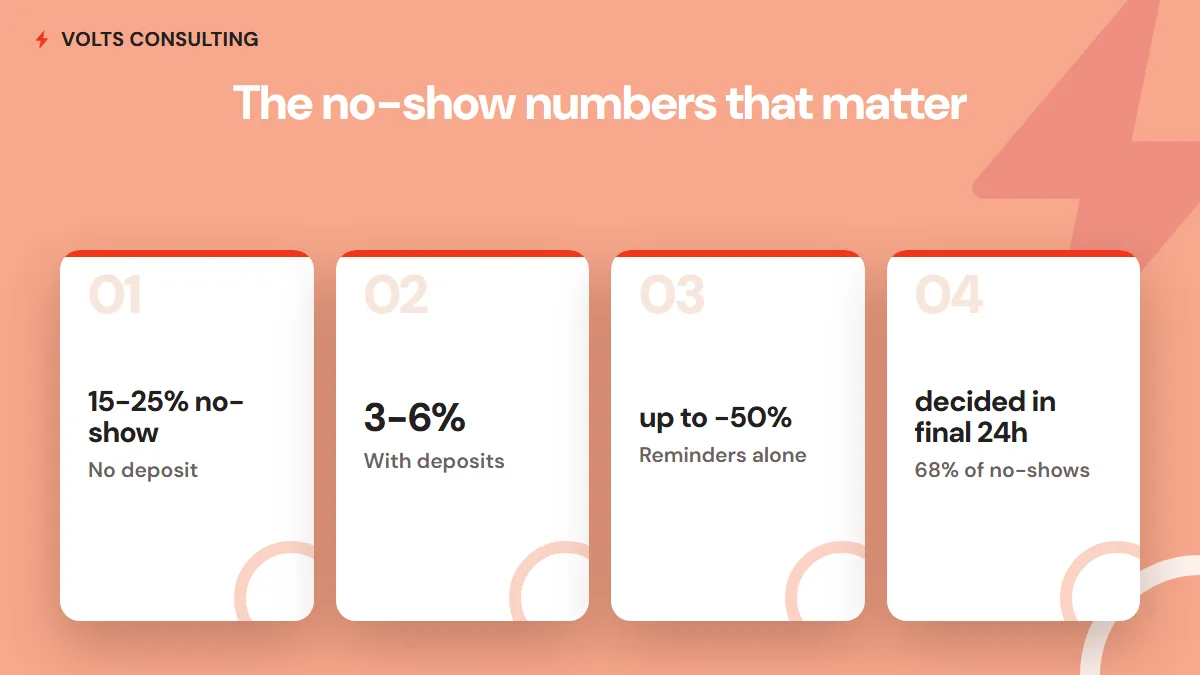
The baseline, from BookrHub's 2026 no-show report: service businesses without deposit systems run 15–25% no-show rates, the average missed appointment costs about $150 for a mid-range operator, and it compounds to $1,500–3,000 a month. (Want your number instead of the average? We built a free no-show cost calculator — three sliders, no signup.) One more number explains most of what follows: 68% of no-shows happen within 24 hours of the appointment — too late to refill the slot. Your goal isn't just fewer no-shows; it's earlier decisions.
Ranked by impact
1. Deposits — the only fix that changes the decision
Everything else on this list reminds or nudges. A deposit moves the commitment to booking time, when the slot can still go to someone else — and the data gap between it and everything else is embarrassing: businesses adding deposits see 60–80% fewer no-shows, landing at 3–6% rates, with 80% seeing the improvement inside 30 days.
The mechanism matters: a reminder helps the client who forgot. Only money on the line changes the client who half-meant it. Industry norm is 20–30% of the service price, scaled by how much a miss costs you, always credited against the final bill, and transferable with reasonable notice — the full how-much-and-how-to-roll-it-out playbook is in our deposits guide, written for salons but portable to any appointment business.
The honest cost: mild booking friction. A few impulse bookings won't complete payment — disproportionately the ones that wouldn't have shown. Walk-in-heavy, low-ticket businesses may rationally skip deposits; almost everyone else is leaving the single biggest lever unpulled because asking feels awkward.
2. A reminder ladder — automated, multi-step, multi-channel
Reminders are the fix everyone implements, usually badly: one email the night before. Done properly — confirmation at booking, 24 hours out, and same-day, by SMS or WhatsApp where open rates actually live, not just email — automated reminders cut no-shows by up to half on their own, and add another 20–30% reduction on top of deposits.
The design principle comes from that 68%-in-the-final-24-hours number: the same-day reminder is the one that catches the decision as it's being made. And "automated" is load-bearing — reminder systems that depend on a human remembering to send reminders have a predictable failure mode.

3. Make rescheduling easier than vanishing
Counterintuitive but consistently true: a one-tap reschedule link in every reminder reduces no-shows, because most no-shows aren't malice — they're a conflict plus the awkwardness of calling to admit it. Give people a shame-free exit and they take it, turning a dead slot into a moved one you can refill. Add reply-to-confirm ("reply 1 to confirm, 2 to reschedule") and you also get early warning: the booking that never confirms is the one to double-check.
4. A written policy, stated at booking — and actually applied
A cancellation policy nobody sees until they break it isn't a policy, it's a future argument. State it in the booking flow and the confirmation message: the notice window, what happens inside it, how deposits transfer. Then apply it consistently — the business that waives every fee trains its calendar's worst habits, and the one that enforces with judgment (first-timers get grace, chronic offenders don't) keeps both its slots and its goodwill.
5. A waitlist that backfills
This one doesn't prevent no-shows — it refunds them. When a cancellation lands, an automated waitlist offer ("a 2pm Thursday just opened — want it?") can refill slots that notice-window cancellations create. It pairs with #3: the easier rescheduling is, the more of your losses arrive early enough to backfill.
6. Card-on-file no-show fees — the weaker cousin of deposits
Holding a card and charging after a miss does reduce no-shows, but understand what you're buying: a collections process instead of a commitment. Disputes, chargebacks, awkward calls — you've moved the friction from booking time (where it filters) to after the damage (where it festers). It's the right tool where deposits genuinely don't fit (some medical contexts, corporate clients); elsewhere it's deposits with worse ergonomics.
7. Book the next visit before they leave
The humble one: a client who leaves with their next appointment booked — made concrete in person, with a reminder ladder behind it — shows up at dramatically higher rates than one who "will call to book." Zero software required. Low ceiling, zero cost, every repeat-visit business should do it anyway.
What doesn't work
For balance, the popular non-fixes: more than three reminders (you're training people to ignore you, and SMS fatigue is real), guilt-trip messaging ("we lost money because of you" — they just don't come back at all), blanket blacklisting after one miss (you're firing recoverable customers for being human), and overbooking like an airline (works until the day everyone shows, which is the day you lose three regulars at once).
By industry, quickly
Salons and barbers: deposits per service + the ladder is the proven combo — full playbook here. Detailing and mobile services: a no-show costs the drive too, so deposits earn their keep faster — and durations vary enough that per-service deposit amounts matter more than a flat rate. Clinics and consultants: where regulation or norms make deposits awkward, lean hardest on #2, #3 and #6, and consider prepaid packages — a course of sessions paid upfront is a deposit wearing a different name.
The software checklist
Whatever system you run, the no-show toolkit above requires: per-service deposits (fixed or percentage) collected at booking, a confirmation → 24-hour → same-day reminder ladder on email/SMS/WhatsApp, one-tap confirm and reschedule, policy text in the booking flow, and a waitlist. That list is, not coincidentally, a description of VoltsBook — free plan, no commission on your takings, deposits included — but check your current system first; you may be paying for half these features and using none.
FAQ
What's a normal no-show rate? Without deposits: 15–25% across service industries (hair 15–20%, nails and barbershops 20–30%). With deposits and a reminder ladder: 3–6%. If you're over 20%, you're not unlucky — you're unprotected.
What reduces no-shows the most? Deposits, by a wide margin — 60–80% reduction versus up to 50% for even well-built reminders. Most businesses implement them in the reverse order of effectiveness because reminders require no awkward conversation.
How many reminders should I send? Three, tied to the booking: confirmation immediately, 24 hours out, and same-day. The same-day one matters most — 68% of no-shows are decided in the final 24 hours. Past three, returns go negative.
Should I charge a no-show fee or take a deposit? Deposit, where your industry allows it. A deposit is money already committed that you keep or credit; a fee is money you have to go take, with the disputes that implies. Prevention beats collection.
Do no-show texts and policies scare off customers? They filter more than they scare. The booking that evaporates at a 20% deposit was a soft booking; the regular who objects to a transferable, credited-to-your-bill deposit is rarer than the fear suggests. Businesses in BookrHub's data overwhelmingly see the trade pay inside a month.
If your calendar is leaking four figures a month to empty slots, start at #1 and work down — the first two fixes get you most of the way. And if your current booking system can't do per-service deposits or a proper reminder ladder, VoltsBook's free plan can, today, without taking a cut of what you earn.