

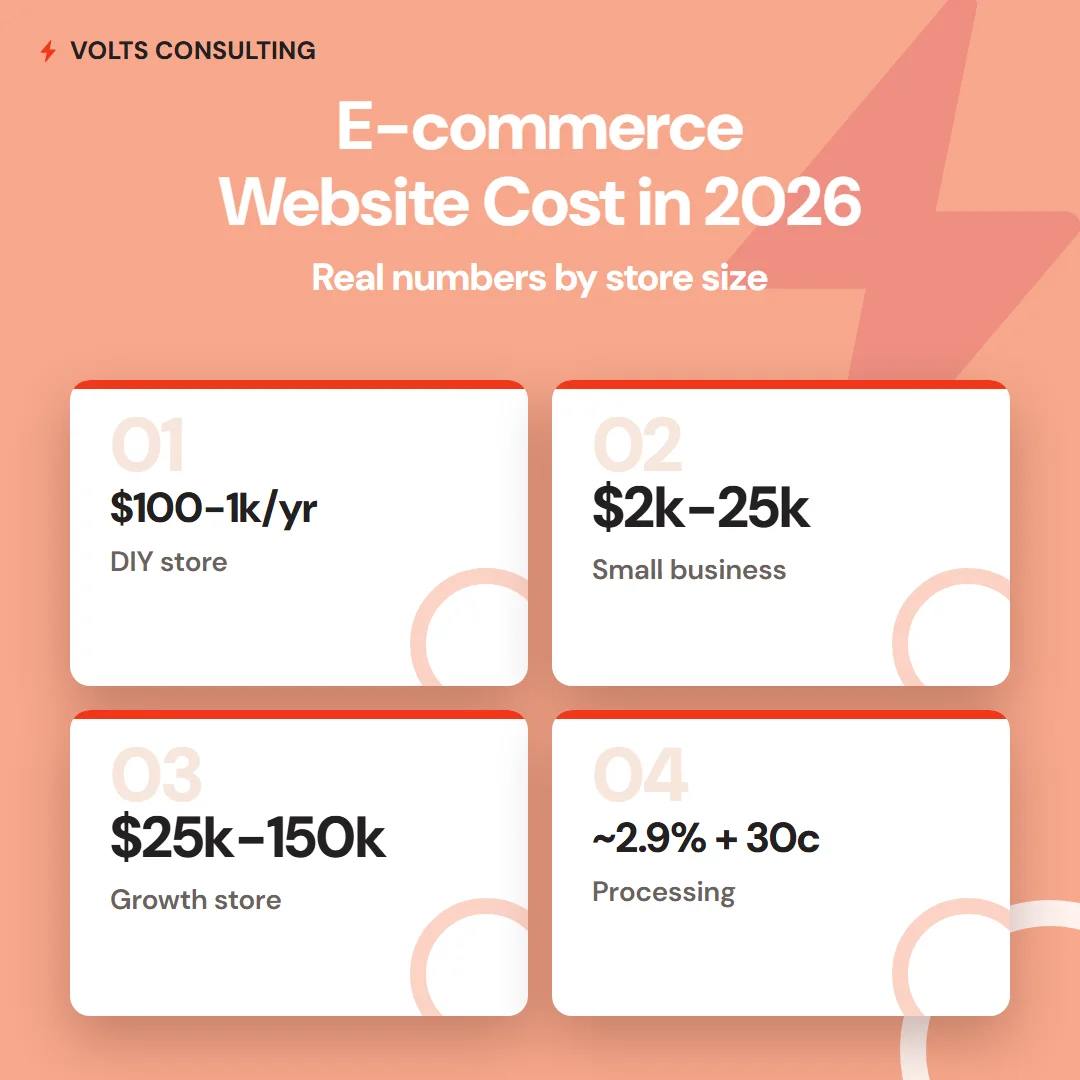
E-commerce website cost in 2026 runs from a few hundred dollars a year for a DIY store to $25,000+ for a professionally built small-business store, and $25,000 – $150,000+ once a growing brand needs custom work — with enterprise builds far beyond that. Averages hide more than they reveal here, because an online store isn't one purchase: it's a build cost, a platform subscription, a payment-processing rate, and an app stack that all bill differently. This guide lays out each layer with real market numbers — the same math behind our e-commerce design work and our website development quotes.
What does an e-commerce website cost in 2026?
The market, cross-checked across current platform and agency pricing guides:
| Store stage | Build cost | Typical ongoing (monthly) | Who it fits |
|---|---|---|---|
| DIY on a builder | $0 – $1,000 of your time + setup | $40 – $100 | Testing an idea, first ~50 orders |
| Small business store | $2,000 – $25,000 | $100 – $500 | Real catalog, professional design, first hires |
| Growth / mid-market | $25,000 – $150,000 | $500 – $2,500+ | Custom UX, integrations, serious traffic |
| Enterprise / B2B / headless | $75,000 – $500,000+ | $2,500+ | Large catalogs, ERP integration, multiple markets |
Read the ranges the honest way: the bottom of each band is template-driven with light customization; genuinely custom design and integrations start from the middle up. (If you're weighing DIY against hiring at all, start with custom vs website builder — the trade-offs matter more in e-commerce than anywhere else.)
What do the platforms themselves cost?
Platform pricing guides each push their own answer, so here's the neutral side-by-side:
| Platform | Subscription | Typical build cost | Transaction cost |
|---|---|---|---|
| Shopify | $39 – $399/mo (Plus from ~$2,300/mo) | $2,000 – $25,000 themed; more custom | 2.4 – 3.5% via Shopify Payments |
| WooCommerce (WordPress) | Free + hosting $25 – $350/mo | $3,000 – $30,000 | Gateway rate (Stripe ~2.9% + 30¢) + extensions $29 – $299/yr each |
| Wix / Squarespace | $27 – $49/mo | $0 – $5,000 | ~2.9% + gateway terms |
| BigCommerce | $29 – $299/mo (Enterprise custom) | $2,000 – $25,000 | Gateway rate, no added platform fee |
| Custom / headless | Hosting $50 – $1,000+/mo | $25,000 – $150,000+ | Gateway rate |
No platform is "cheapest" in general — each is cheapest for a shape of business. Shopify buys reliability and the best checkout with a monthly rent and a design ceiling; WooCommerce buys ownership with maintenance responsibility; custom buys freedom and speed at real build cost. We walk through the fit question honestly on the e-commerce design page.
Where does the build budget actually go?
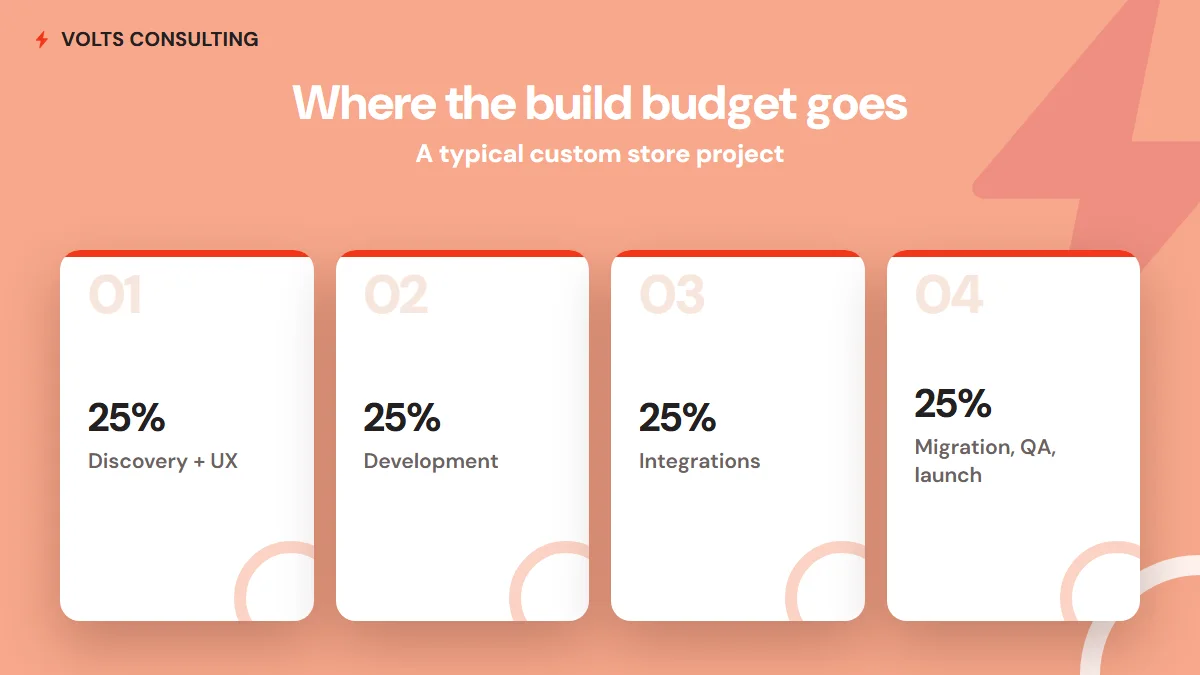
On a professional store build, the money splits roughly into quarters: discovery and UX design (catalog architecture, page designs, checkout flow), development (theme or storefront build, product templates), integrations (payments, shipping, tax, inventory, email, accounting), and migration, QA, and launch. The drivers that move your project up or down the range:
- Catalog size and variant complexity. 40 products with two sizes is a different build from 4,000 SKUs with bundles.
- Design depth. Configured theme vs. designed brand experience — the biggest single multiplier.
- Integrations. Every system your store must talk to (ERP, POS, 3PL, marketplaces) is real engineering.
- Content. Product photography and copy are budget lines someone must own — "client provides content" is where store launches stall.
The ongoing costs the quote doesn't mention
The build price is the down payment. The recurring layer is where store budgets actually get surprised:
- Payment processing scales with success. At ~2.9% + 30¢, a store doing $100,000 a year hands roughly $3,000 of it to the processor — at $1M, roughly $30,000. It's the largest "invisible" cost in e-commerce and it appears in almost no cost guide.
- App-stack creep is the new hosting bill. Reviews, email, bundles, subscriptions, loyalty — each app is $10 – $50/month, and typical stores quietly reach $200 – $500/month in app subscriptions by their first anniversary. Audit the stack twice a year.
- Maintenance: budget 10 – 25% of the build cost per year for updates, fixes, and small improvements — the same ratio we flagged for web apps, because a store is one.
- Growth work: SEO and content typically run $150 – $5,000/month depending on ambition; paid ads are their own budget entirely.

What does replatforming cost?
The question almost every cost guide skips — even though most store owners reading one already have a store they've outgrown. Moving platforms (Wix → Shopify, aging WooCommerce → custom) is typically 30 – 60% of the equivalent new-build price, because products, customers, and order history migrate, and — critically — the SEO must survive: URL mapping, 301 redirects, metadata and structured data carried over, rankings verified after cutover. Replatforming done carelessly resets years of Google equity; done properly, it's a line item, not a gamble. Budget it explicitly and ask any agency to walk you through their migration checklist before you sign.
Three realistic first-year budgets
- Starter D2C brand, Shopify theme, ~60 products: $3,000 – $8,000 build + ~$150/month platform and apps → first year ≈ $5,000 – $10,000 plus processing.
- Established retailer going serious, custom-designed Shopify or WooCommerce store, integrations to accounting and shipping: $15,000 – $35,000 build + $300 – $700/month → first year ≈ $20,000 – $43,000.
- Growth brand where the storefront is the brand, custom/headless build: $50,000 – $120,000 + real infrastructure → first year ≈ $60,000 – $140,000 — justified only when design and performance are demonstrably winning you customers.
Anchor any of these to unit economics, not gut feel: if your average order is $80 with healthy margin, the middle scenario pays for itself somewhere between 400 and 900 incremental orders — a number you can actually sanity-check against your traffic.
How do you keep an e-commerce budget honest?
- Fix the scope before comparing quotes — product count, integrations list, content ownership, launch date. Vague scopes produce incomparable quotes (we covered the pattern in website design cost).
- Model three years, not launch day. Build + (monthly × 36) + processing at your projected revenue. A cheap build with an expensive app stack often loses to a dearer build with fewer moving parts.
- Spend where customers feel it: product pages, checkout, speed. Cut where they don't: features for the 1% of orders.
- Demand an itemized quote. Ours are fixed, written, and itemized after a scoping call — typically within 48 hours — and hold unless the scope changes.
If you want a real number for your store instead of a range, book a free strategy call — we'll scope your catalog, integrations, and platform fit honestly, including when the answer is "stay on your builder for another year."
Frequently asked questions
How much does an e-commerce website cost for a small business? Professionally built, most small-business stores land between $2,000 and $25,000 depending on catalog size and design depth, plus $100 – $500/month in platform, hosting, and apps. Below that you're in DIY-builder territory — legitimate for validating demand.
Is Shopify cheaper than WooCommerce? Up front they're comparable; the difference is where the cost sits. Shopify charges predictable monthly rent and handles the infrastructure; WooCommerce is cheaper in fees but you own hosting, updates, and security — or pay someone to. Total three-year costs converge more than fans of either admit.
Why do quotes for the same store vary so much? Because "an online store" hides every variable that matters: catalog size, custom design vs theme, integrations, migration, content. Fix the scope in writing and the quotes snap into comparability — the outliers that remain are telling you something.
How long does an e-commerce website take to build? A packaged store on Shopify or WooCommerce typically launches in four to six weeks; custom and headless builds run eight to twelve weeks or more depending on integrations. The schedule risk is rarely the development — it's product content. Photography, descriptions, prices, and shipping rules have to exist before launch, so settle who owns them in week one.
Can I start on a builder and upgrade later? Yes, and for a first store it's often the right call. Just treat replatforming as a planned future cost (roughly 30 – 60% of a new build) rather than a surprise, and keep ownership of your domain, product data, and customer list from day one so the move stays clean.