

Most "best self-hosted CRM" lists are written the same way: sort GitHub by stars, paraphrase five README files, publish. You can tell because they rank software by how it demos, never by what it's like to be responsible for it in month eighteen — when a PHP upgrade looms, an extension goes unmaintained, and the person who set it all up has questions to answer.
We can write the other version. Our agency runs on a self-hosted CRM in production — a Perfex-based platform we built and maintain ourselves — and we do CRM development for clients professionally. Full disclosure runs in both directions here: we also sell VoltsCRM, a managed option, which means we profit when you decide self-hosting isn't for you. Consider the incentives cancelled out and read on.
Why self-host at all — and the cost nobody itemizes
The case for self-hosting is real: your customer data on your server in your jurisdiction, no per-seat tax that punishes growth, and software that can't be re-priced, "sunset," or feature-gated under you. For a 10-person team, the SaaS comparison isn't subtle — mainstream CRM at $15–50/user/month runs $1,800–6,000 per year, forever, against a self-hosted stack that costs a few hundred to stand up and $36–720/year to host.
The cost the lists skip: you become the vendor. Updates, backups, security patches, the 9pm fix — someone on your side owns all of it now. That's a few hours a month that are fine to spend if they're planned, and expensive if they're a surprise. Every ranking below weighs that burden, because it's the actual price of self-hosting.
The field, ranked by what you're actually choosing
Twenty — the modern one
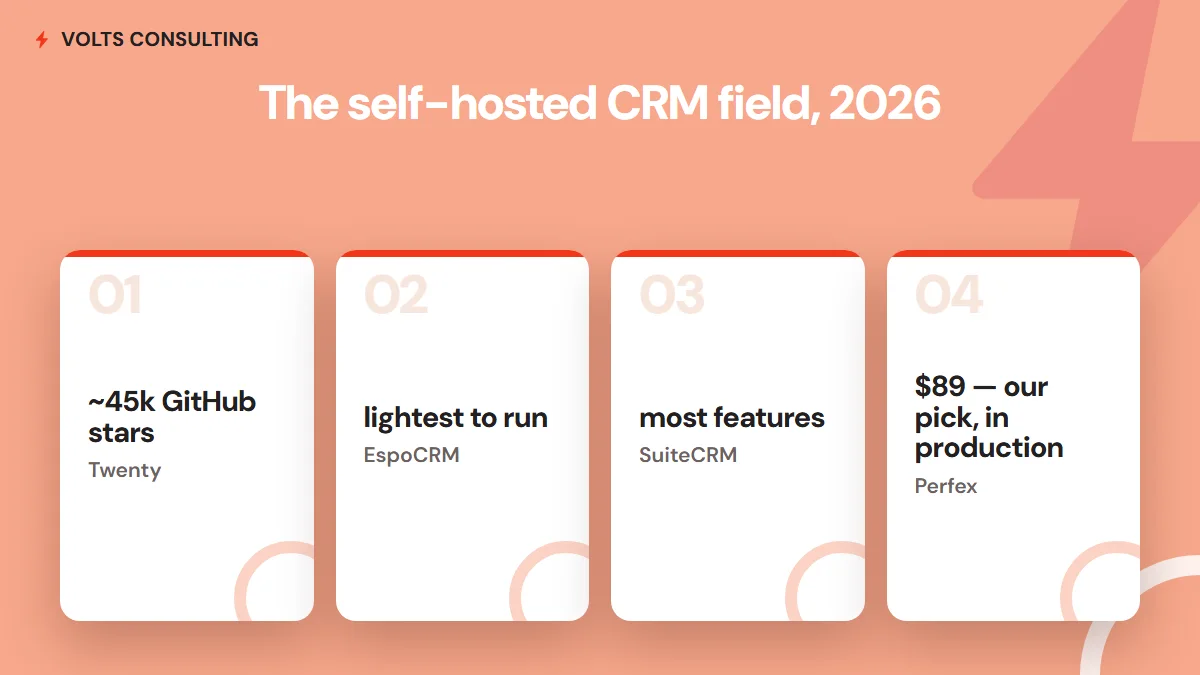
Twenty is the current darling, with good reason: it's the only self-hosted CRM that looks and feels like software designed this decade (think Attio/Notion energy), it's genuinely open source, and its community is the most active in the space — around 45,000 GitHub stars as of October 2026.
The honest trade: it's young. The feature surface is sales-pipeline-centric — contacts, companies, deals — without the invoicing, projects, and ticketing an operations-heavy small business leans on. And it's Docker-first, which is great if "docker compose up" is a sentence you enjoy and a wall if it isn't.
Pick Twenty if you're a tech-comfortable team that wants a beautiful sales CRM, owns a VPS without fear, and doesn't need invoicing inside the same tool.
EspoCRM — the sensible one
EspoCRM is what we'd call the quiet professional's choice: a mature, genuinely lightweight PHP application that installs on ordinary shared hosting, runs fast on minimal hardware, and has been steadily maintained for over a decade. Of everything on this list, it carries the lowest admin burden per feature.
The honest trade: the free core is leaner than it first appears — some meaningful capabilities live in paid extensions, and the interface is pleasant but plain. Nobody falls in love with EspoCRM; plenty of businesses quietly run on it for years.
Pick EspoCRM if you want the least possible sysadmin life, standard CRM features done competently, and a straight upgrade path.
SuiteCRM — the heavyweight
SuiteCRM (the long-running SugarCRM fork) remains the most feature-complete fully open-source CRM: workflows, reporting, quotes, territories — enterprise furniture the others don't have.
The honest trade: it feels like the enterprise software it forked from. Heavier to host, slower to learn, and the interface will not win your team's affection. The depth is real; so is the weight.
Pick SuiteCRM if you have genuinely complex CRM requirements, a technical owner for it, and you'd otherwise be priced into enterprise SaaS.
Odoo (Community) — the everything one
Odoo isn't a CRM; it's an open-source ERP in which CRM is one of dozens of apps — invoicing, inventory, HR, websites. For a business that wants one system for everything, the Community edition self-hosted is a legitimately remarkable amount of software for free.
The honest trade: scope is the product and the trap. Odoo projects balloon, the Community/Enterprise line is drawn commercially (useful pieces sit behind it), and self-hosting a system this large is real infrastructure work.
Pick Odoo if you're consciously buying an ERP journey, not a CRM.
Perfex — the commercial outlier (and our pick, with caveats)
Perfex CRM breaks the purity test: it's self-hosted but commercial — $89 one-time, source included, not OSS-licensed — which is why the GitHub-stars lists skip it. That's a filtering error. For a service business, Perfex ships the operations layer the FOSS options make you assemble: invoicing, proposals, projects, tickets, contracts and a client portal in one coherent system, with a large module ecosystem on top.
The honest trade: the UI is functional, not fashionable; the no-Kanban pipeline is a real gap for sales-led teams; quality across the module catalogue varies (buy carefully, and never nulled); and $89 isn't the real total — the honest number lands between $200 and a few thousand depending on how far you take it.
Pick Perfex if you're a service business that invoices clients and runs projects — the thing it does that nothing else here does as completely. It's what we bet our own operation on, and the bet has paid.
Also worth knowing: Dolibarr (lighter Odoo-flavored ERP/CRM, charmingly old-school), vTiger (long-running, community edition lags the cloud product), and Krayin (Laravel-based, promising, young).
The comparison in one table
| License | Software cost | Stack | Admin burden | Best fit | |
|---|---|---|---|---|---|
| Twenty | Open source | Free | Docker/Node | Medium-high | Modern sales teams, technical |
| EspoCRM | Open source | Free core + paid ext. | PHP/MySQL | Lowest | Standard CRM, minimal fuss |
| SuiteCRM | Open source | Free | PHP/MySQL | High | Complex requirements |
| Odoo CE | Open source | Free core | Python/Postgres | Highest | Whole-business ERP ambitions |
| Perfex | Commercial, source incl. | $89 one-time | PHP/MySQL | Medium | Service businesses that invoice |

When you shouldn't self-host
Two honest exits. If you're one or two people with a simple pipeline, a mainstream SaaS free tier costs you nothing and demands nothing — self-hosting at that size is a hobby, which is only fine if you know you're buying a hobby. And if your team has nobody who wants to own a server — not "could," but wants to — then self-hosted software becomes everyone's problem and no one's job. That failure mode is exactly why we built VoltsCRM as a managed platform, and why we'll also happily set up and maintain a self-hosted install for you if you want ownership without the 9pm part.
FAQ
What's the best free self-hosted CRM? EspoCRM for most businesses — lightest to run, mature, complete enough in the free core. Twenty if your team is technical and sales-focused. "Free" still buys your admin time; budget it honestly.
Is a self-hosted CRM actually cheaper than SaaS? At 5+ users, almost always — the per-seat math is brutal over three years. At 1–2 users, usually not, once your time is priced. The crossover is sharper the more seats and the fewer migrations you expect.
How technical do I need to be? EspoCRM and Perfex: comfortable-with-cPanel is genuinely enough, especially on good shared hosting — the requirements are modest. Twenty and Odoo: you want real Docker/server comfort, or someone hired who has it.
Can I migrate from HubSpot/Zoho/Salesforce to a self-hosted CRM? Yes — contacts, companies and deals move via CSV everywhere, and the API-equipped options support deeper migrations. The practical loss is usually automation and email history, which take deliberate rebuilding. Plan the migration as a project, not an afternoon.
Which one do you actually use? Perfex, extended with modules we wrote ourselves, hosted on infrastructure we manage. Not because it's the prettiest — because a service business runs on invoices, projects and tickets, and we wanted all three attached to the customer record on a server we own.
If data ownership is the goal but running servers isn't your idea of a business, talk to us — setup, migration, custom modules, or VoltsCRM if you'd rather it simply be handled. We'll tell you plainly which bucket you're in, including "use the free SaaS tier, you're two people." And if the honest answer is that no product fits your process, that is what custom software development is for.