


Search for the best Perfex CRM modules and notice who's answering: module stores. Every ranking page in this niche is written by someone with fifty modules to sell you, which makes their "top 13 must-have add-ons" lists exactly as trustworthy as a bakery's list of must-have pastries.
Here's our position, stated plainly: we don't sell a single catalogue module. We're a Perfex development shop — we run our own agency on a Perfex-based platform, we've bought and lived with catalogue modules in production, and we build custom ones when the catalogue doesn't fit. That cuts both ways: we make money when off-the-shelf fails you, so weigh our "go custom" advice with the same skepticism we're aiming at the stores. What follows is the buying framework we use ourselves, with the incentives on the table.
The three-bucket rule
Every module decision lands in one of three buckets, and getting the bucket right matters more than picking the "best" module in it:
- Buy — the need is generic, the module is proven, and configuring it beats building it by an order of magnitude.
- Skip — the need is vague, the module overlaps something you own, or the seller can't show recent updates.
- Build — the need is your business, and bending a $40 generic module around it costs more than owning the code.
Bucket one: modules genuinely worth buying
The catalogue has hundreds of modules; the ones below earn their place in most serious installs. Where we quote numbers, they're from the public CodeCanyon listings as of September 20, 2026 — verifiable, not vibes.
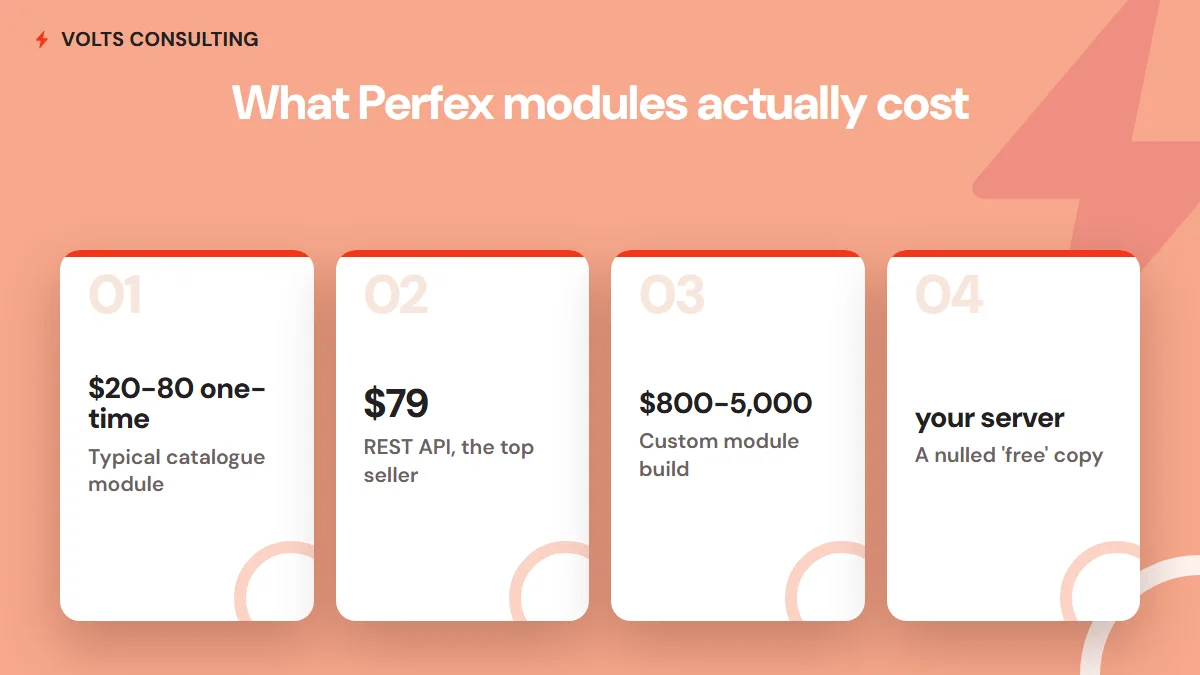
The REST API module — buy it first. Stock Perfex has no meaningful API, which quietly makes it an island. The REST API module is the catalogue's proven fix: 3,006 sales, 4.91/5 across 46 reviews, $79, last updated September 15, 2026 — that update recency is the stat that matters most, and it's the module we lean on for Perfex API integrations constantly. If your CRM will ever talk to a website form, an automation platform, or anything with a webhook, this is the least speculative $79 in the ecosystem.
An email/mailbox module. Working support and sales email inside the CRM, against the customer record, instead of alt-tabbing to webmail. One of the catalogue's long-standing best-sellers for a reason: the value is obvious the first week.
A WhatsApp integration. If your customers live on WhatsApp (ours do — half our client base is small US and Indian service businesses), a maintained WhatsApp module turns the CRM into the place conversations actually get recorded. Check which API tier it uses (official Cloud API vs. unofficial bridges — the unofficial ones are cheaper and fragile).
The SaaS/multi-tenancy module — for a specific ambition. If you're planning to resell Perfex as your own product, a commercial multi-tenancy addon is the sane route; it's the one we configure for white-label SaaS builds rather than pretending anyone should write tenancy isolation from scratch. If you're not building a SaaS, this module is bucket two.
Bucket two: what to skip
- Anything overlapping what you own. The most common wasted purchase we see in client audits isn't a bad module — it's a duplicate: a project-management module beside stock projects, a second reporting suite, two notification systems fighting over the same events.
- Modules without a changelog heartbeat. Perfex itself updates several times a year; a module last touched eighteen months ago is a compatibility incident on a timer. No recent updates, no purchase — however good the screenshots.
- The 80% module. If the demo does most of what you need and you're already listing the exceptions, stop. You're not buying a module, you're buying a customization project with a stranger's code as the foundation — usually the worst of both worlds.
- Nulled anything. "Free" copies of paid modules are the single most reliable way to hand your customer database to a stranger — we wrote a full audit guide on nulled Perfex modules after seeing what actually ships inside them. The CVEs get patched for licensed users and stay open forever on pirated copies.
The pre-purchase checklist
Five minutes on the listing page answers most of it. Before any module purchase, verify:
- Last update date — within the last 6 months, ideally weeks. Cross-check against the current Perfex version's release date.
- Compatibility statement — does it name the current Perfex major version explicitly, or say "3.x" hopefully?
- Review content, not score — read the 3-star reviews specifically; that's where "support stopped answering" lives.
- Support terms — CodeCanyon support is 6 months by default; know what renewal costs before you depend on the module.
- What happens at Perfex's next update — search the comments for the last Perfex release's name and watch how fast the author responded. That response time is your future downtime.

Bucket three: when custom beats the catalogue
A custom module runs roughly $800–$5,000 depending on scope — ten to fifty times a catalogue purchase. It's the right answer in exactly three situations:
- The workflow is your competitive edge. A freight company's quote logic, a clinic's intake flow, an agency's fulfilment pipeline — when the process is what customers pay you for, generic software subtracts from it. This is why our own platform runs on modules we authored: the workflow is the product.
- The integration doesn't exist. Catalogue modules cover Stripe and Mailchimp; they don't cover the ERP your supplier mandates or the government portal your industry files into. Custom is the only aisle stocking those.
- You've outgrown a bought module. The honest upgrade path from the 80% module: keep what works, rebuild the gap properly — as a real module, not core edits, so Perfex updates stop being scary. (Why that distinction matters is the whole subject of our module development page.)
The wrong reason to go custom: pride. If a maintained $79 module does the job, buying it is the senior-engineer move — we tell paying clients that weekly, sometimes to our own quote's detriment. The full cost picture across license, hosting, modules and custom work is broken down in what Perfex actually costs.
FAQ
How many modules is too many? There's no magic number, but every module is a dependency with its own update cycle. Installs with 15+ modules from ten different authors are where we get called for "Perfex broke after updating" emergencies. Buy deliberately; a lean install with five well-chosen modules beats a christmas tree.
Do modules slow Perfex down? Well-built ones, barely. Badly built ones, dramatically — the usual sins are unindexed queries and hooks that run on every page load. If Perfex got slow after an install, you have your suspect; deactivate and measure. (Module weight is also one of the few honest reasons to upgrade your server — see our hosting requirements guide.)
Can I get my module customized by someone other than its author? Legally, generally yes for your own install (check the license); practically, it depends on code quality, and it creates an update problem — the author's next version overwrites third-party changes. When we modify a bought module for clients we wrap changes in a separate companion module where possible, precisely so updates stay safe.
Where should I buy — CodeCanyon or third-party stores? CodeCanyon is the main catalogue with escrowed reviews and visible sales history — that transparency is worth a lot. Direct stores sometimes price lower or bundle support differently; judge them by the same checklist above, and be more careful, not less, when the social proof is thinner.
What's the first module a new Perfex install should get? The REST API module, almost regardless of business type — it keeps every future integration possible. After that, buy against pain you've actually felt, not lists like this one.
If you're staring at a module page wondering which bucket you're in, that's literally a conversation we have for free: tell us what you're trying to make Perfex do, and we'll tell you honestly whether the answer costs $79 on CodeCanyon or is worth building properly — including when it's the $79.