
Creative, UI/UX, WebsiteOctober 2026
Alvis Bansal
- Client
- Alvis Bansal
- Industry
- Game Art · 3D
- Services
- Art Direction & UIWeb Development3D on the WebBooking
- Live Page
- Open Project
Case Study
Five working directions for an artist whose work ships in AAA games.
Alvis Bansal models weapons, vehicles, props and environments for games — his credits include Call of Duty, Diablo IV and Remnant II. A portfolio for that audience can't be a template, so we didn't design one direction and hope. We built five complete, working sites, each borrowing from a game artist's own tools, and refined the strongest into the live portfolio.
01
The Challenge
The people who hire a 3D game artist — art directors, leads and studio recruiters — look at a lot of portfolios, fast. They want the work at full resolution, the credits up front, and a way to get in touch, in about that order. Alvis's artwork already lived on ArtStation; what he lacked was a home of his own that made his shipped credits — 12 games, from Call of Duty: Modern Warfare II and Vanguard to Diablo IV, Remnant II, Suicide Squad: Kill the Justice League and The Outer Worlds 2 — impossible to miss.
A first, conventional pass — split hero, card grid — was rejected on sight. It looked like every other portfolio, which for an artist is the one thing a portfolio can't do.
02
Five Directions, All Built
Rather than mock up options, we built each direction as a working site, so the choice was made on how they felt to use — and each one took its idea from a game artist's own tools. All four explorations are still live to try: one, two, three and four.
-
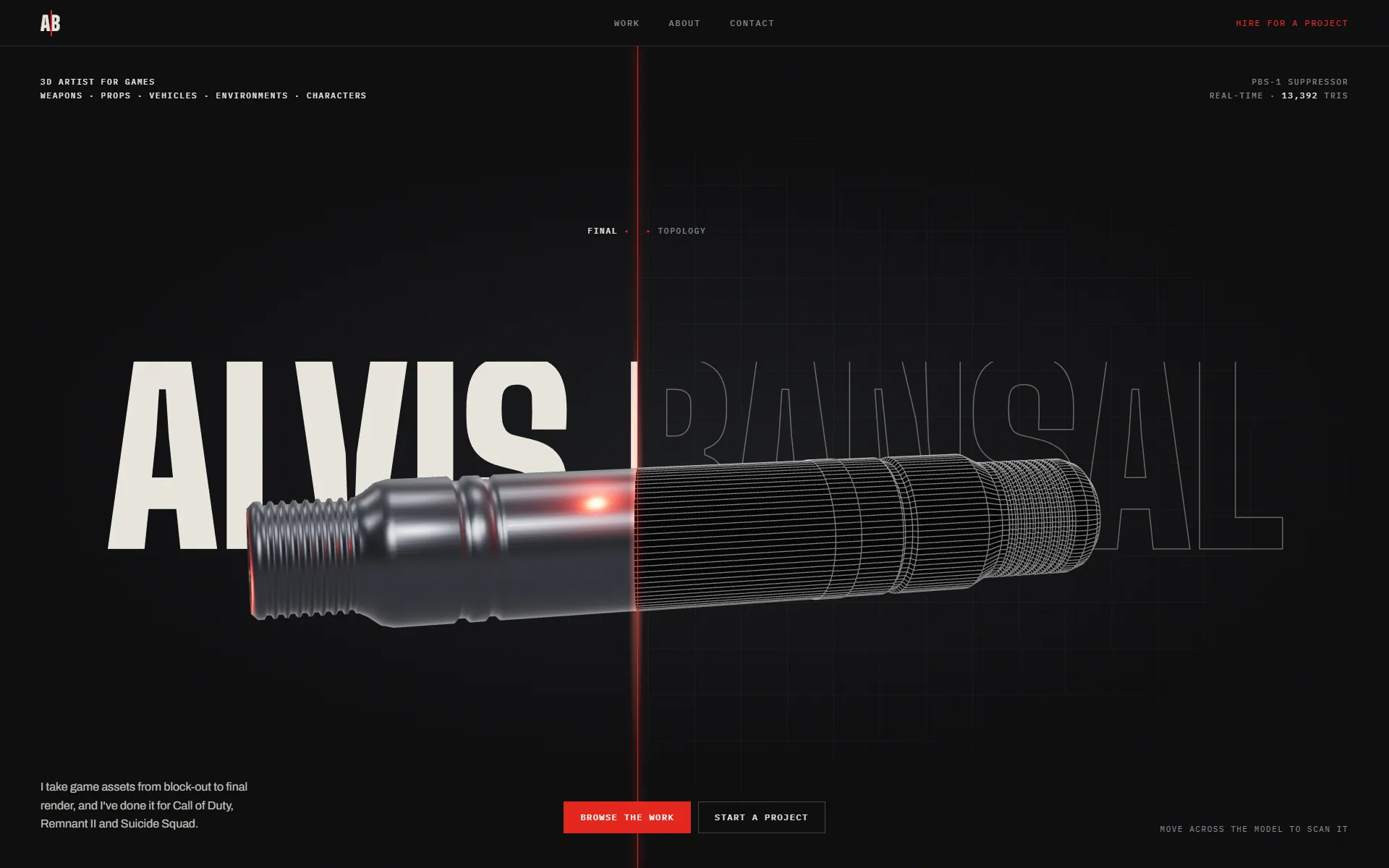
Hero Scan. A procedural suppressor rendered live in WebGL, split by the cursor into the final render on one side and its wireframe topology on the other — the modelling pipeline as the hero. Work was browsed like a game's inventory screen.
-
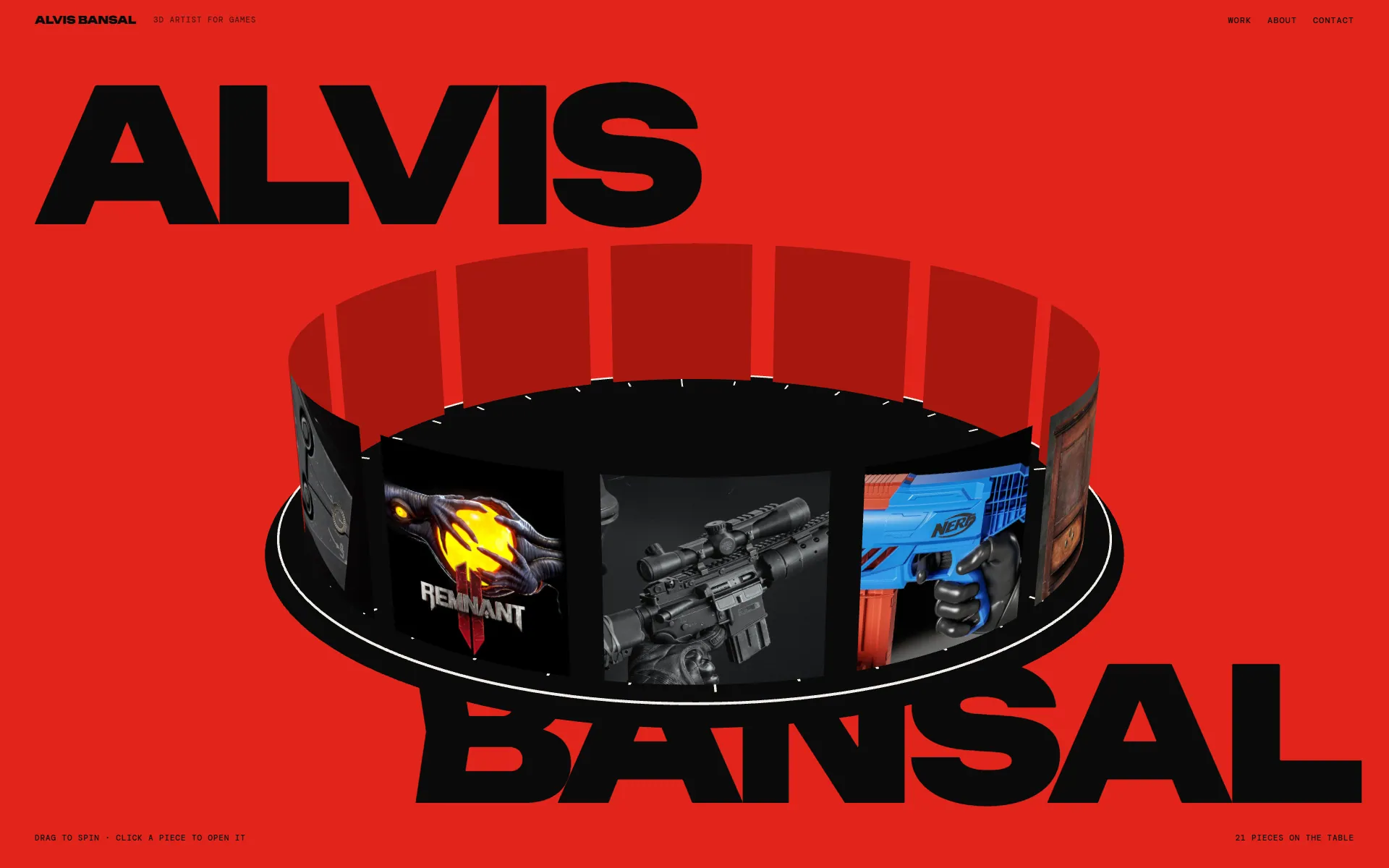
Turntable. Red poster typography around a spinning 3D platter of renders, like a model on a presentation turntable.
-
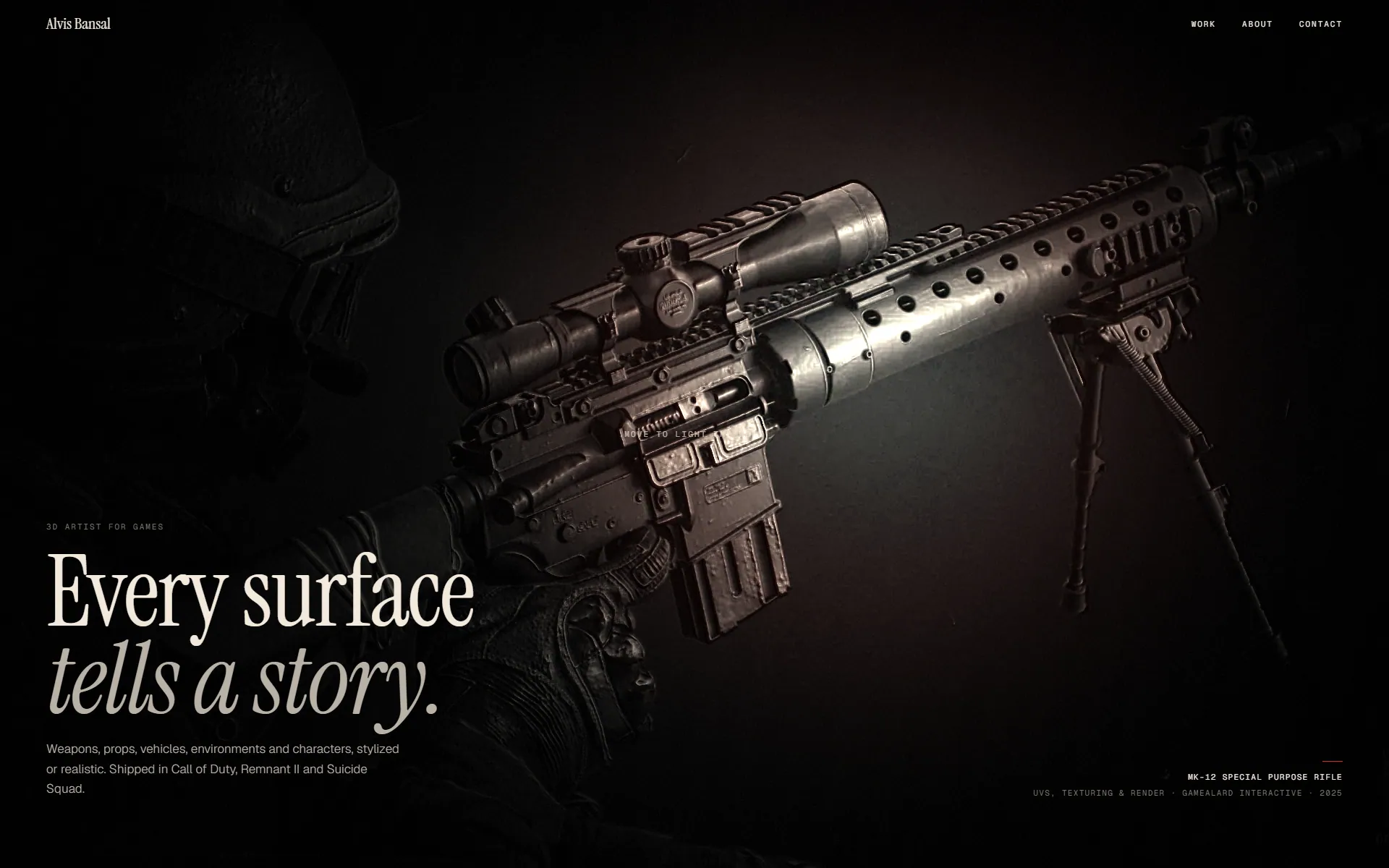
Torchlight. WebGL relights a render from the cursor, so the visitor holds the torch and discovers the surface detail.
-
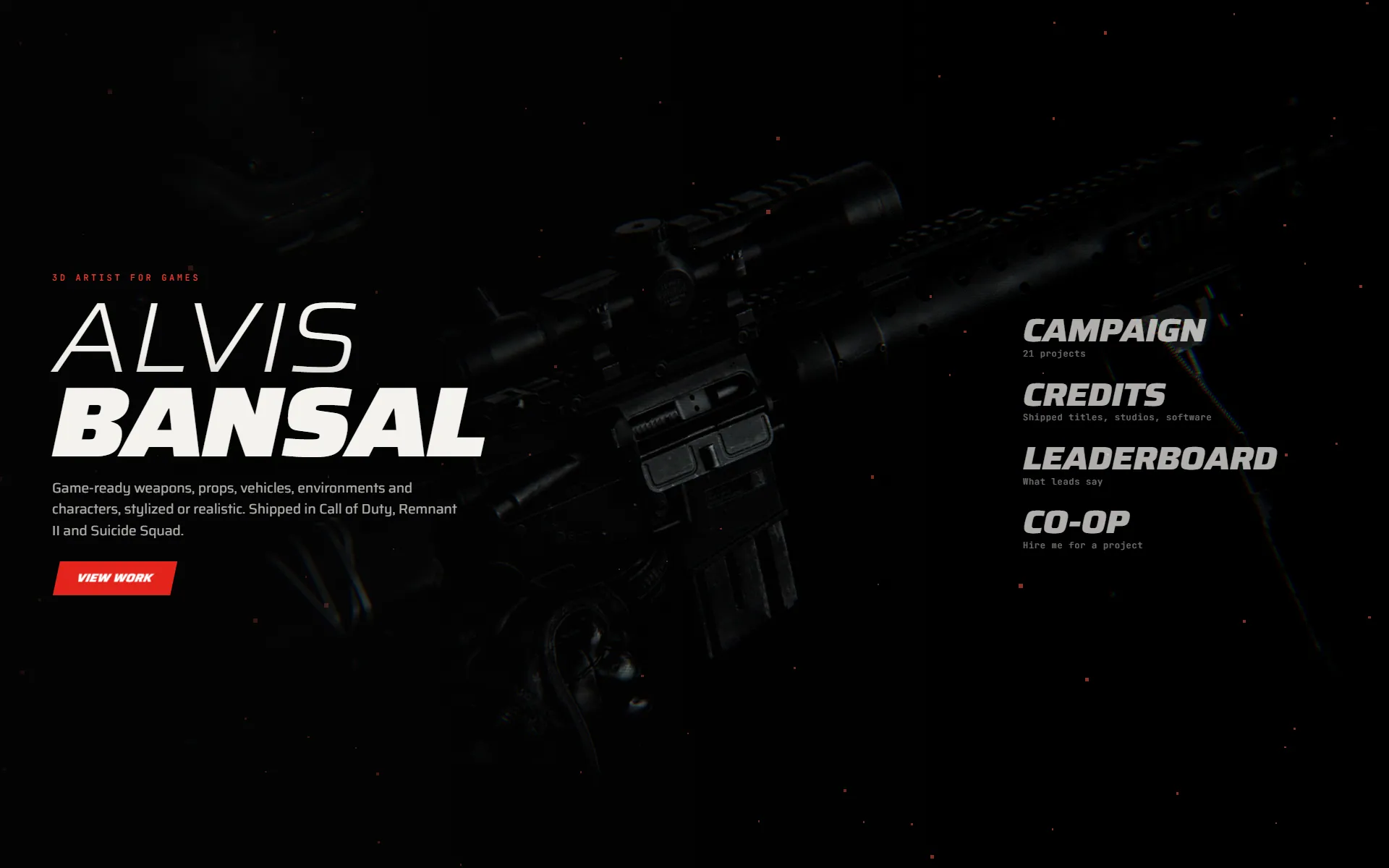
Main Menu. A game front-end look. The first version was a full game shell, down to a "Press any key" gate — striking, and in the way. It became a normal portfolio with game styling: labels load as game terms like Campaign and Co-op, then glitch into the real ones, Work and Contact.
03
What the Directions Taught Us
Building every direction for real meant each one was judged on use, not on a still frame — and each left a rule behind for the final site.
The work comes first
The most technical effects were the hardest to see the art through. Anything that hides a render, even beautifully, goes.
Game flavour, plain navigation
Game styling earns its keep; game mechanics don't. Labels and paths must read like a normal portfolio.
Real numbers only
Credits, studios and shipped games are the proof — shown as facts, never padded into vanity stats.
04
The Final Site
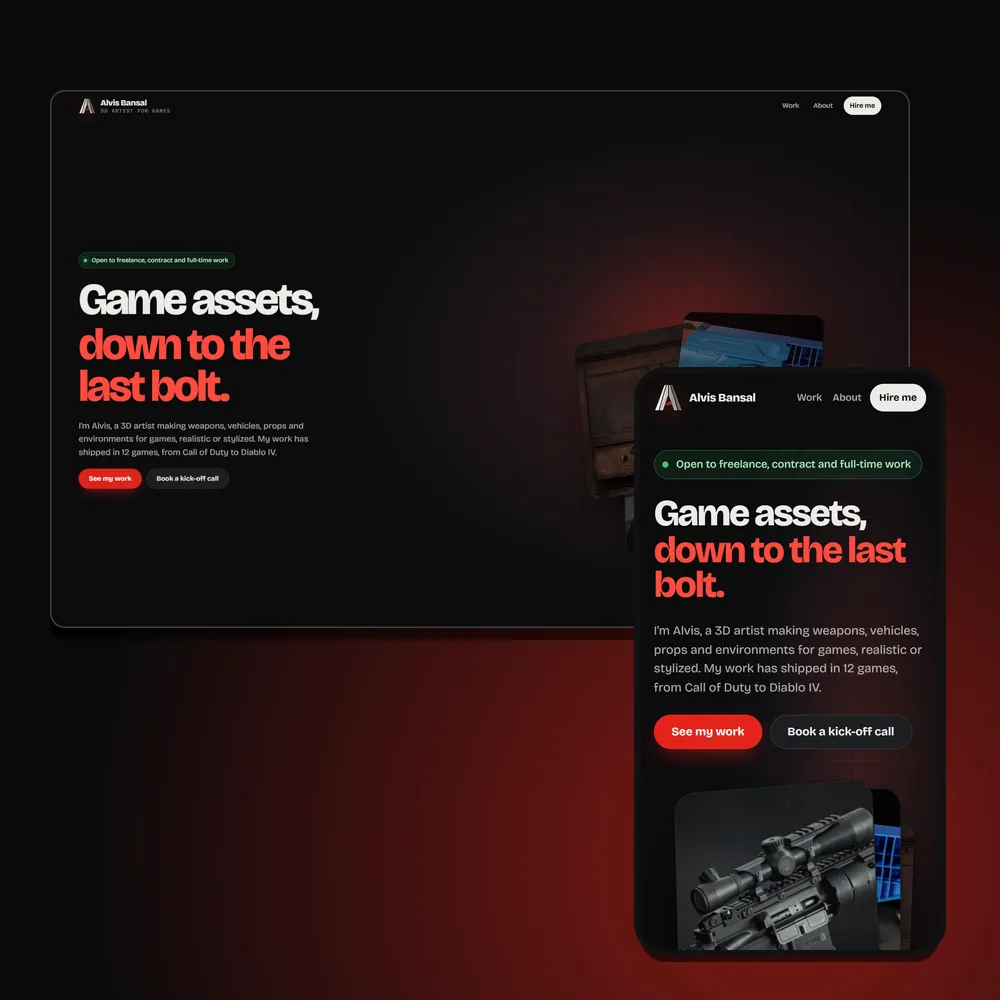
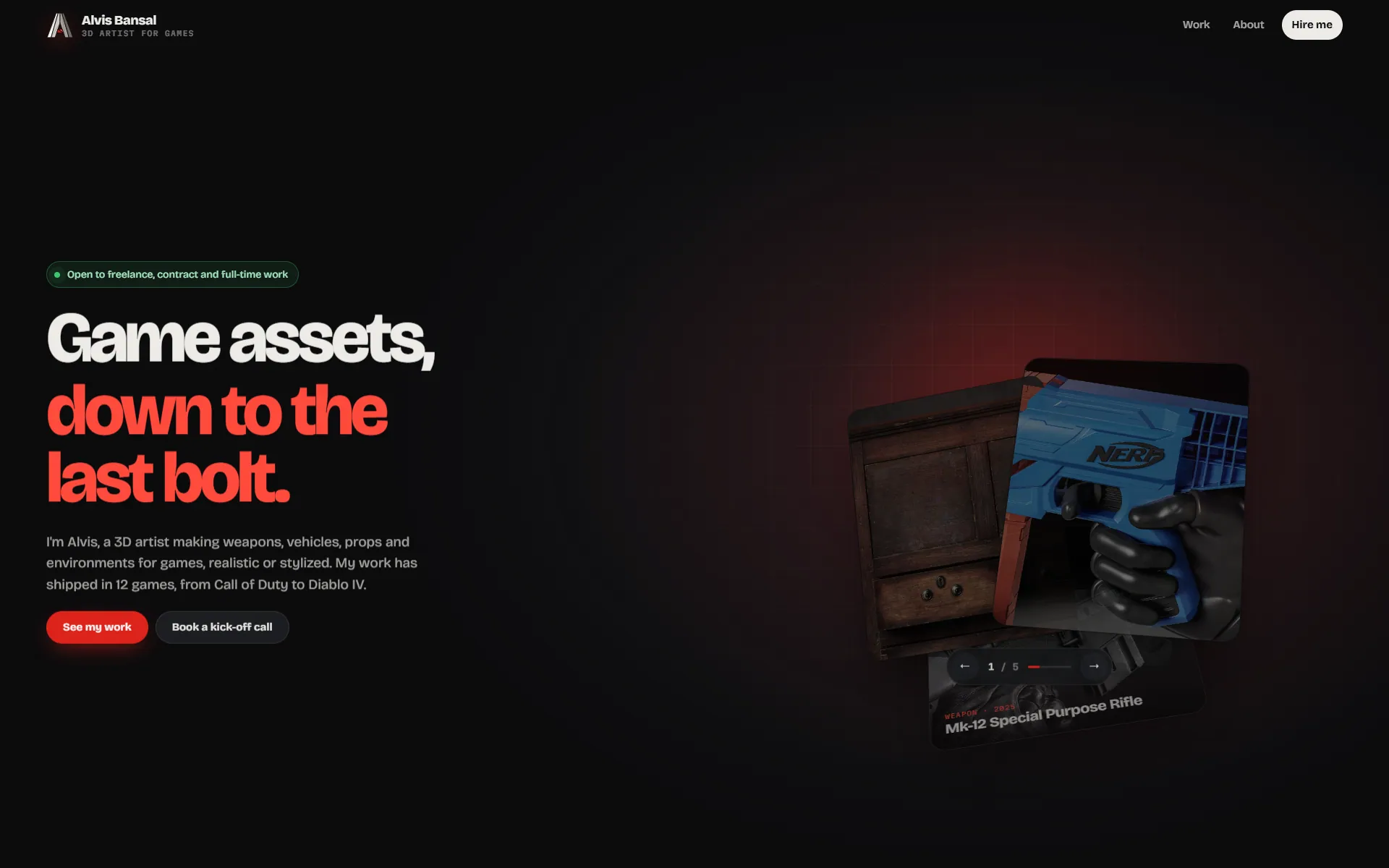
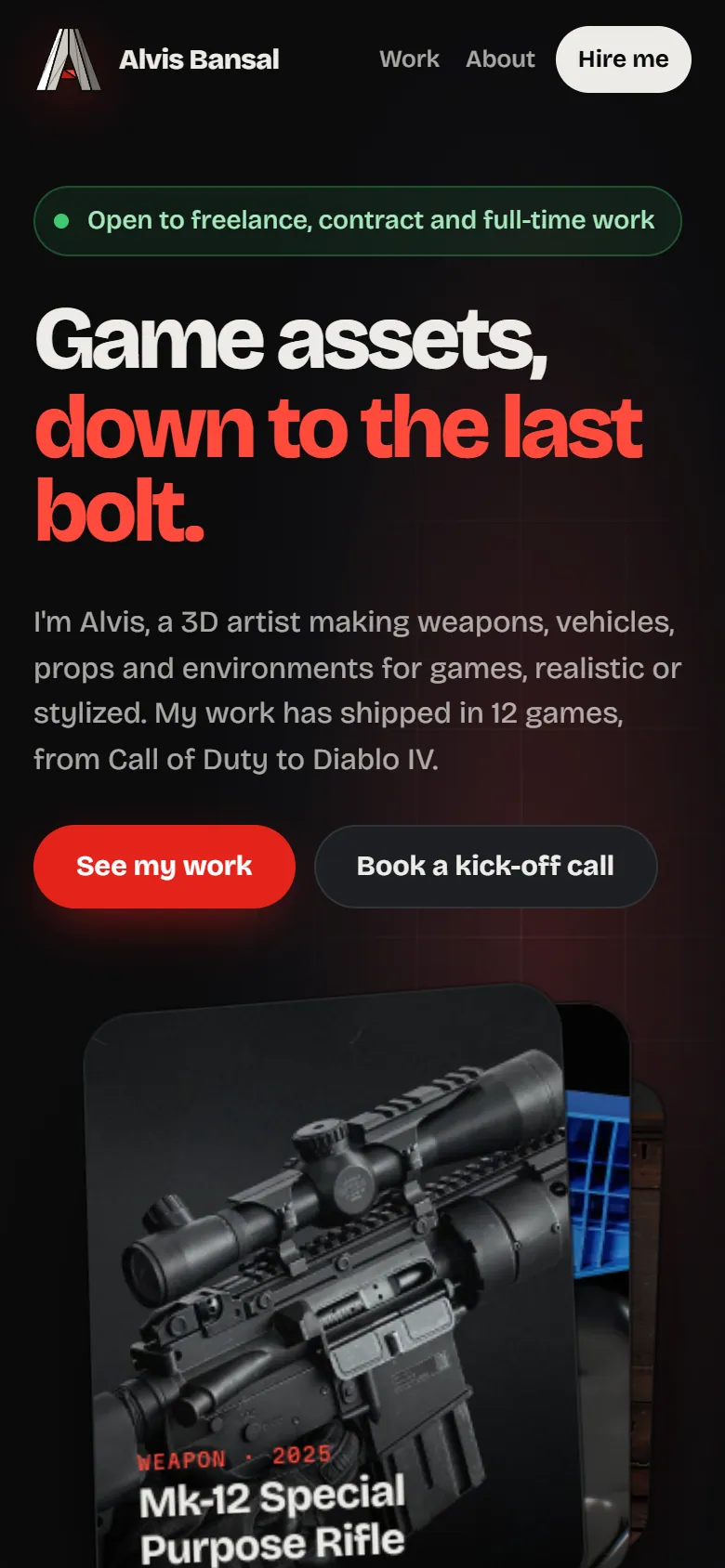
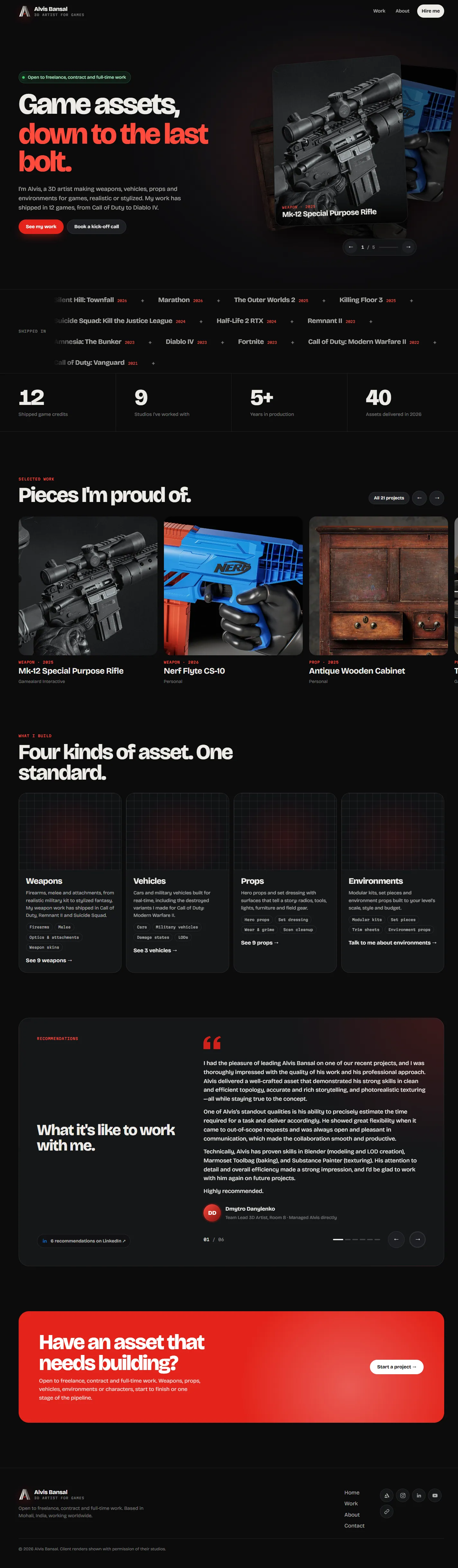
The fifth direction won, and we refined it until it felt finished. Its hero is a 3D card deck of featured renders that flies in on load, tilts with the mouse and cycles itself — after an earlier exploded-view hero was cut for competing with the work. The headline says what he does in his own trade's terms: Game assets, down to the last bolt. A faceted low-poly "A" became the logo.
Below it: a marquee of the 12 productions he has shipped on, real stats, and a What I build section where weapons, vehicles, props and environments each spin as live clay-render 3D models in the browser. Every project page carries the full ArtStation gallery in a lightbox, the About page shows his game credits and software, and recommendations from colleagues appear verbatim. Kick-off calls book straight through VoltsBook. Every motion respects reduced-motion settings.
It runs on plain PHP and SQLite with a back office, so Alvis edits his own projects, galleries, credits, reviews and settings without touching code.
Collaboration
Got a project?
Let's talk.
We're a team of creatives who are excited about unique ideas and help companies to create amazing identity by crafting top-notch UI/UX.