

Mobile car detailing is one of the lowest-risk, highest-demand businesses you can start in 2026. There's no storefront to lease, you can get going with a few thousand dollars of equipment in a vehicle you may already own, and you drive to the customer — which is exactly the convenience busy car owners happily pay a premium for.
But "low-risk" isn't the same as "no plan." The detailers who build a real income (instead of an expensive hobby) treat it like a business from day one: they get licensed, price for profit, and make themselves easy to find and book online. This guide walks through all of it — the true startup costs, the licenses and insurance you need, the equipment to buy, how to price your packages, and the part most guides gloss over: how to actually get customers once your van is stocked.
Is a mobile detailing business worth it?
For most people starting out, yes. The math is friendly and the demand is steady.
The upside:
- Low overhead. No lease, no utilities, no build-out. Your biggest cost is equipment, and you can start lean.
- Come-to-you premium. Convenience is the product. Customers pay more for a detailer who shows up at their home or office than for a fixed-location wash.
- Recurring revenue. Interiors and paint need ongoing care. A monthly maintenance plan turns one-time jobs into predictable income.
- You control the schedule. Start as a weekend side hustle and scale into full-time or a small team.
The trade-offs to plan around:
- Weather and seasonality. Rain and winter slow you down. Ceramic coatings, interior work, and indoor jobs help smooth the dips.
- It's physical. This is real, hands-on work — especially early, when you're the whole company.
- You have to market. Skill alone doesn't fill a calendar. Being findable and bookable is what separates busy detailers from quiet ones.
What it costs to start
Your single biggest variable is the vehicle. If you already own a van, SUV, or truck that can carry your gear, your out-of-pocket start is genuinely small. If you need to buy a rig, budget for that separately. Everything else falls into predictable ranges:
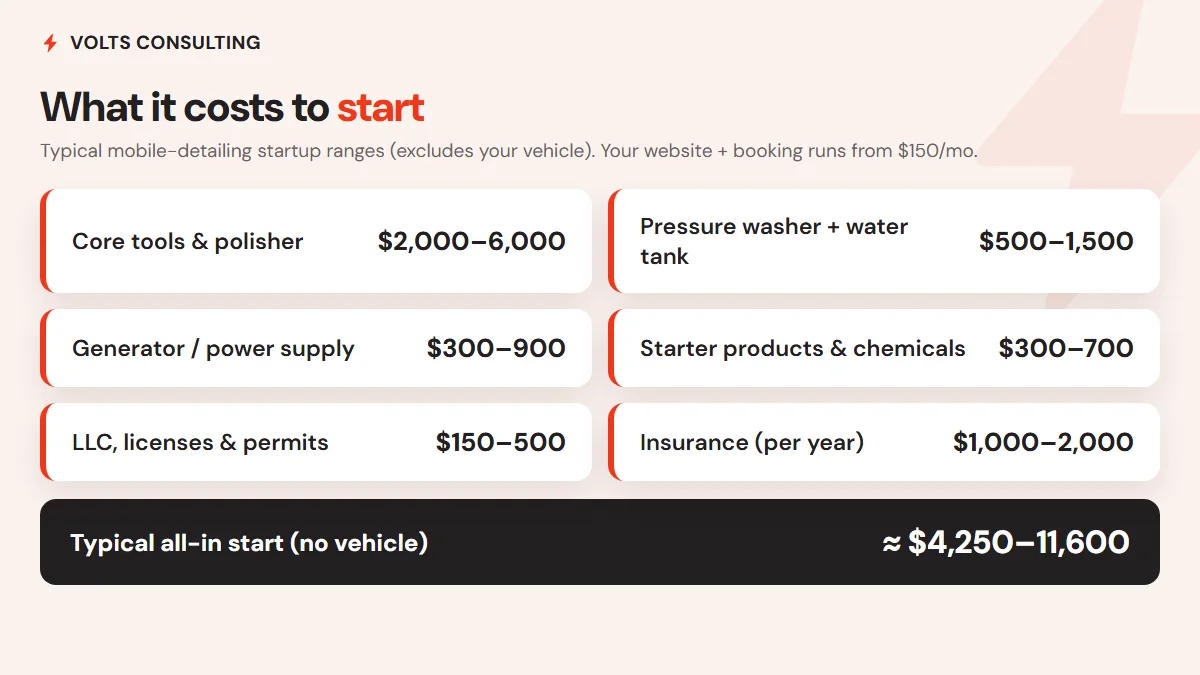
A realistic all-in start (not counting a vehicle) lands somewhere around $4,250 to $11,600, depending on how much gear you buy up front. Resist the urge to over-equip. Start with the essentials that let you deliver a great wash, interior, and basic protection, then reinvest your early profits into higher-margin equipment like a dual-action polisher and ceramic coating supplies.
One recurring cost worth planning for from day one is your online presence. A professional website with built-in booking runs from about $150/month — far cheaper than the jobs it books for you, and the difference between looking like a pro and looking like a hobbyist.
The 8-step plan to launch
Here's the sequence that gets you from idea to booked jobs without skipping the steps that cause headaches later.
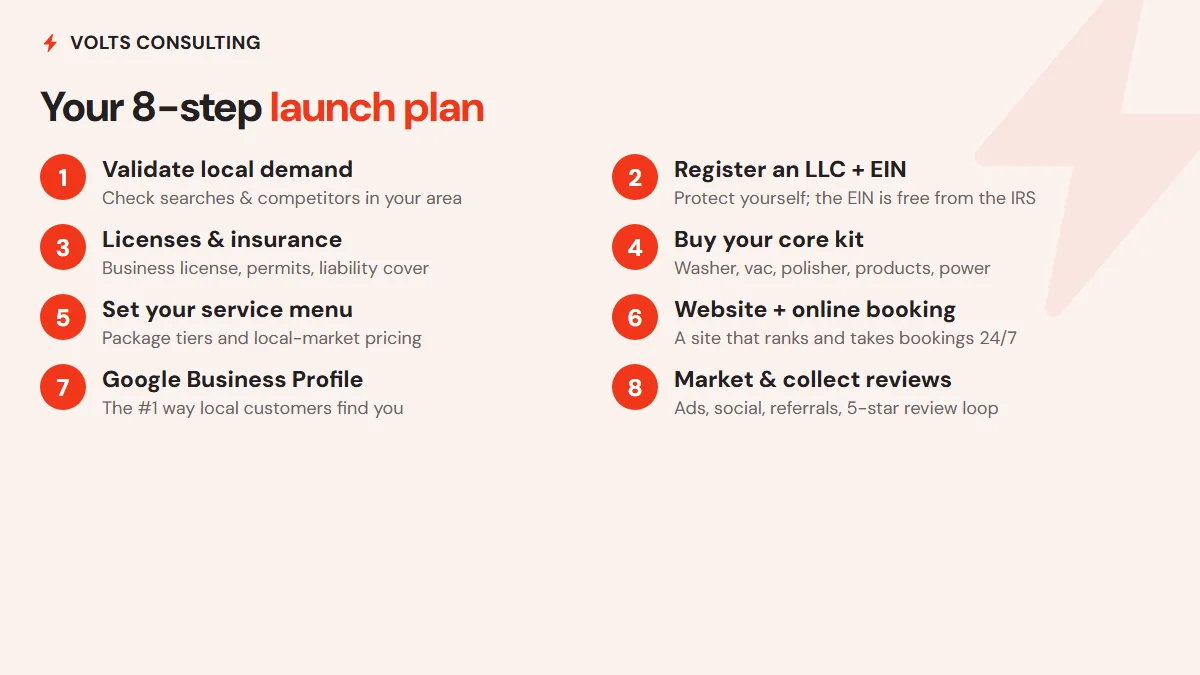
1. Validate demand in your area
Before you spend a dollar, spend an hour on Google. Search "mobile detailing near me" and "car detailing [your city]" and study who shows up. Read their reviews — what do customers praise, and where do they complain? Look at their prices and services. You're looking for gaps: a neighborhood nobody serves well, a service (ceramic coating, pet-hair removal, fleet work) that's underserved, or competitors with weak websites you can out-market.
2. Register your business (LLC + EIN)
An LLC is the most common structure for mobile detailers because it separates your personal assets from the business — if something goes wrong on a job, your house and savings are protected. After you form the LLC, get an EIN (Employer Identification Number) from the IRS. It's free, takes about five minutes online, and you'll need it to open a business bank account and keep your finances clean.
3. Licenses, permits & insurance
Requirements vary by state and city, so check your local rules — but plan for three things:
- A business license from your city or county.
- Water-discharge rules. This one trips up new detailers: many municipalities regulate wash-water runoff into storm drains. You may need reclaim mats or a waterless/rinseless process to stay compliant. Find out before you get fined.
- Insurance. At minimum, get general liability coverage. Add garage keepers insurance, which protects a customer's vehicle while it's in your care.
4. Buy your core equipment
Buy the essentials, deliver great work, and upgrade as revenue comes in. Here's a starter kit organized by what it's for:
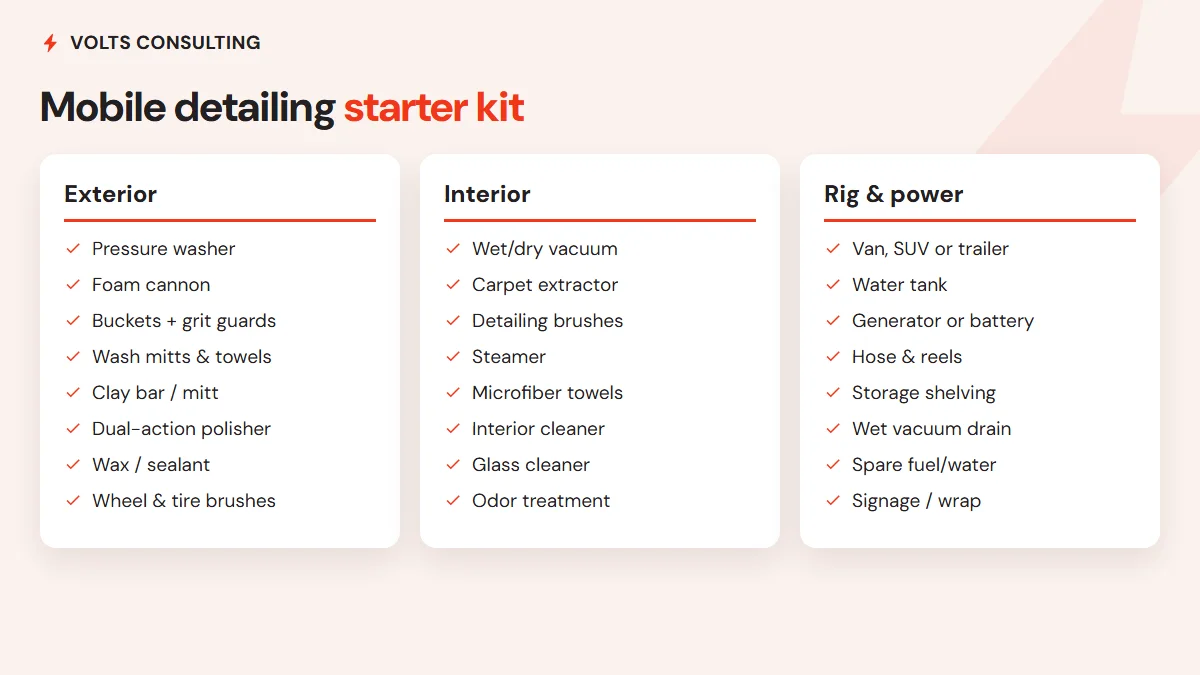
Two rules of thumb: buy microfiber towels in bulk (you'll always want more), and don't cheap out on the tools you use every single job — your vacuum, pressure washer, and polisher.
5. Set your service menu and prices
Package your work into clear tiers so customers can choose quickly, and price for profit — not just to undercut the shop down the road. These are typical U.S. market ranges to anchor against:
| Service | What's included | Typical price |
|---|---|---|
| Express wash & vac | Exterior wash, wheels, interior vacuum & wipe-down | $50–90 |
| Full interior + exterior detail | Deep clean, shampoo, wax | $150–300 |
| Paint correction | Machine polish, swirl & scratch removal | $300–800 |
| Ceramic coating | Multi-year paint protection | $600–2,000+ |
| Monthly maintenance plan | Recurring wash/detail | $80–150/mo |
The real money is in the higher tiers and the recurring plans. For a full breakdown of how to price each service so it's actually profitable, see our guide on how to price your car detailing services for maximum profit.
6. Build a website with online booking
This is where new detailers win or lose. Your customers are searching on their phones at 9 p.m. and want to book in under a minute. If they land on a slow page — or no page at all — they book the next detailer instead.
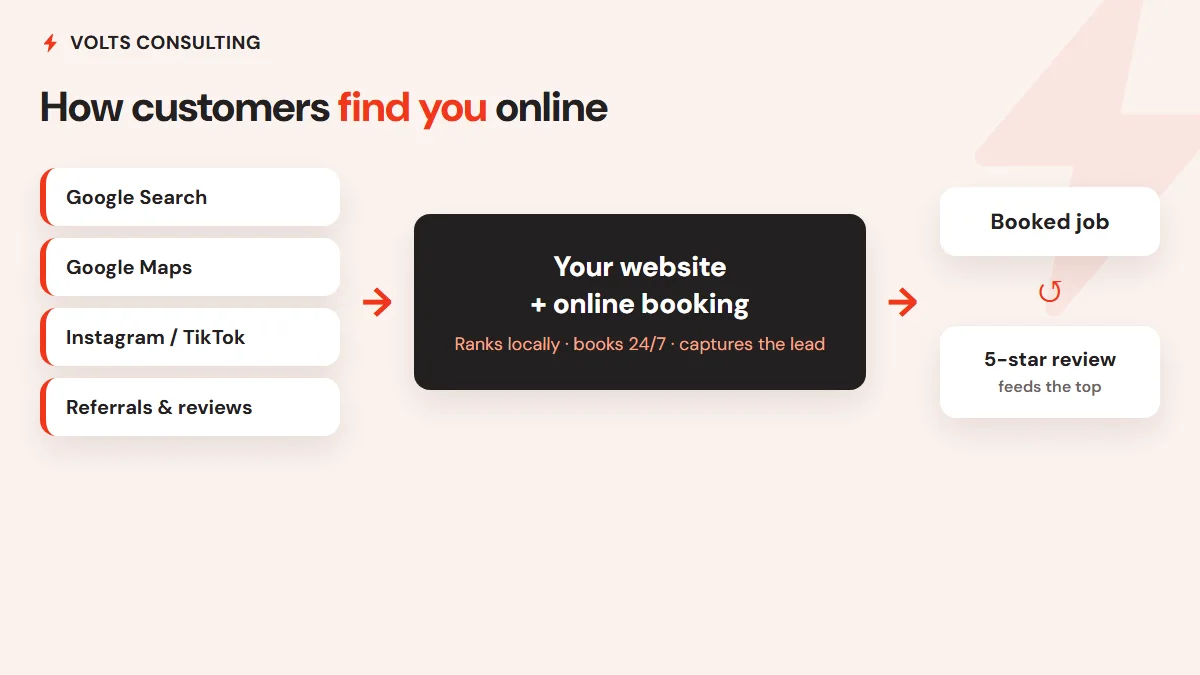
A good detailing website does four jobs: it ranks for local searches, shows off your before-and-after work, collects reviews that build trust, and takes bookings 24/7 so you're earning even when your hands are full. This is exactly what we build for detailers at Volts — websites and marketing designed to turn local searches into booked jobs.
7. Set up your Google Business Profile
Your free Google Business Profile is the single most important tool for getting found locally — it's what puts you on the map (literally) when someone searches "detailing near me." Fill it out completely: correct service area, categories, real photos of your work, your services and prices, and your booking link. Then keep it active with fresh photos and prompt replies to reviews.
8. Market your business and collect reviews
With the foundation in place, it's time to fill the calendar:
- Ask every happy customer for a Google review. Reviews are your #1 ranking and trust signal. Make it a habit at the end of every job.
- Post before-and-afters on Instagram and TikTok. Detailing is visually satisfying — it's made for social video.
- Work local groups and referrals. Neighborhood Facebook groups and a simple referral discount ("give $20, get $20") compound fast.
- Run "near me" ads. A small Google Ads budget targeting local search terms can pay for itself with a couple of jobs.
For a deeper playbook, read our 10 marketing strategies to get more car detailing clients and how detailers can stand out in a competitive market.
How much can a mobile detailer make?
Earnings vary widely with your location, hours, and service mix, so be skeptical of any single number. That said, the pattern is consistent: a single full detail commonly brings in $150 or more, and many solo operators clear $50,000–$100,000 a year once they're established and booked. The detailers who go higher do it two ways — by adding high-margin services like paint correction and ceramic coatings, and by building recurring maintenance plans that guarantee income every month instead of chasing one-off jobs.
Common mistakes to avoid
- Underpricing to win jobs. Cheap attracts price-shoppers, not loyal customers. Compete on quality and convenience.
- Skipping insurance or permits. One incident without coverage can wipe out the business. Get compliant first.
- No online booking. Every hour a customer can't book instantly is an hour a competitor can.
- Ignoring reviews. They're free marketing and free SEO. Ask for them relentlessly.
- Buying too much gear too soon. Start lean, prove the demand, then reinvest.
- No recurring revenue. One-time jobs are a treadmill. Maintenance plans are a business.
Ready to start?
Starting a mobile detailing business in 2026 comes down to two things: doing excellent work, and making it effortless for local customers to find and book you. Get the licensing, equipment, and pricing right — then put a website and Google presence behind it that keeps your calendar full.
When you're ready for that part, see how Volts helps detailers get more clients with websites, booking, and marketing — built specifically for car detailing businesses.