

Ask what a car detailing website costs and you'll get answers from $0 to $10,000, all technically true and none useful on their own. The useful version needs three numbers: what each tier of website actually costs, what a booked job is worth to you, and how many extra jobs a month the site has to produce before it's paying you instead of costing you. That's this post.
Where we stand, so you can weigh it: we've built websites and run marketing for detailing businesses for years — from Logan's Auto Detailing in Los Angeles to Fine Line Detailing in Jacksonville — so we sell the thing this post is about. We've tried to be honest enough below that the "skip the website for now" section is real advice, not a rhetorical trick.
The market rates in 2026
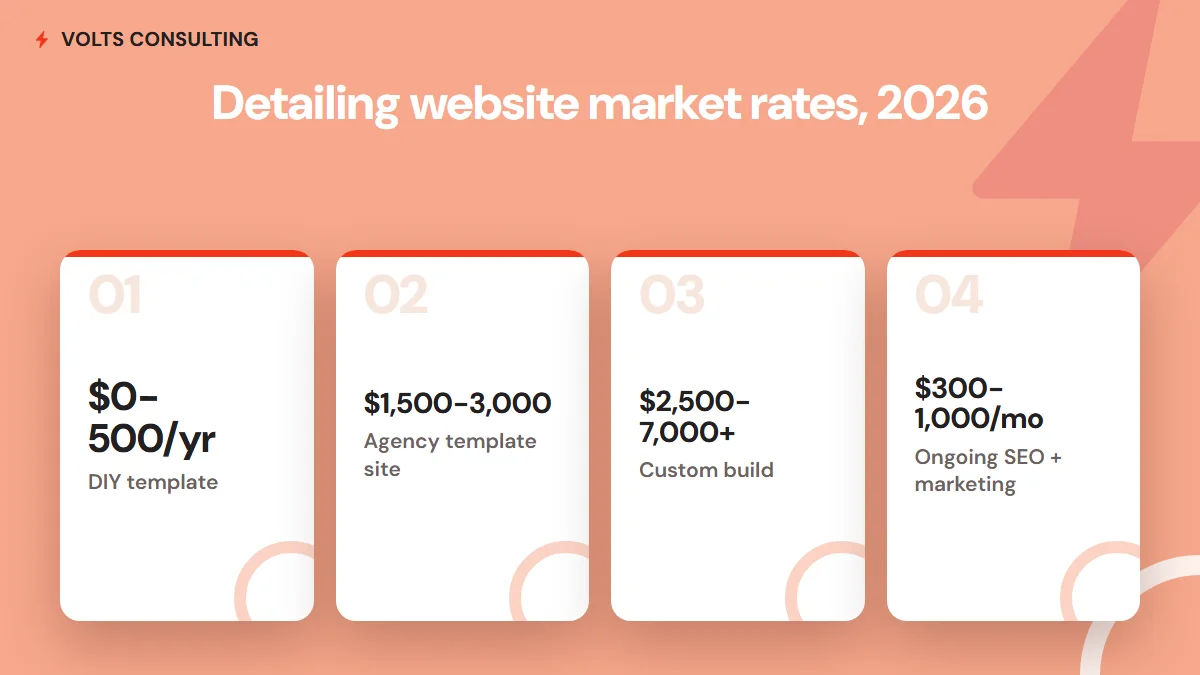
These are market ranges across the industry, not our rate card (our detailing packages live on their own page if you want our specific numbers):
| Tier | What it is | Typical cost |
|---|---|---|
| DIY builder | Wix/Squarespace template you assemble yourself | $0–500/year plus your evenings |
| Template job | An agency skins a stock theme with your logo and photos | $500–1,500 one-time, sometimes monthly |
| Agency template-plus | Stock foundation, real customization, booking wired in | $1,500–3,000 |
| Custom build | Designed for your services, city, and conversion path | $2,500–7,000+ |
| Ongoing marketing | SEO, content, Google Business management | $300–1,000/month |
Two traps hide in that table. The cheap tiers often carry the real cost later — a $500 template that never ranks and never books a job is the most expensive option per job delivered (zero jobs, any price). And at every tier, ongoing marketing quietly outweighs the build: over three years, a $3,000 site with $500/month behind it is a $21,000 program. The build is the down payment, not the purchase.
The payback math
Skip the vanity metrics; a detailing website justifies itself in booked jobs. Run your own numbers on this frame:
- A full detail runs roughly $150–300 in most US markets; ceramic coating jobs run $600–1,500+. Say your blended average ticket is $200, and a chunk of customers become repeat business — so a new customer is realistically worth $400–600 over a year, conservatively.
- A $3,000 site with $400/month marketing costs $7,800 in year one.
- At $500 first-year value per new customer, that's about 16 new customers over the year — 1.3 a month — to break even. Everything past that is margin, and the site keeps working in year two while the build cost doesn't repeat.
That's the whole decision, honestly framed: can a website in your city realistically produce one to two extra customers a month? (Run your own numbers in our website ROI calculator — it models the slow first months honestly.) In any metro where people search "car detailing near me" and "ceramic coating [city]" in real volume, the answer is usually yes if the site can rank and convert — which is a quality question, not a philosophy question. In a small town where everyone already knows the two detailers, the answer may genuinely be no.
When you should NOT buy a website yet
The advice the sales pitch skips:
- You're brand new with no reviews. Your first ten customers come from a free Google Business Profile, Instagram before/afters, and hustle — not a website. Get to reviews first; a site amplifies proof, it doesn't replace it.
- Your calendar is already full at your target prices. A website's job is demand. If your problem is operations — no-shows, scheduling chaos, quoting time — that's booking software money, not website money, and it's a tenth of the price.
- You can't feed it photos. A detailing site converts on before/afters and finished-work galleries. If you won't shoot your work, the best-built site in Texas will still look generic.
- Someone's pitching you a $99/month "website + SEO" bundle. At that price it's a stock template and a monthly report nobody reads. It fails the payback math not because it's cheap but because it produces nothing to pay back.
What actually makes a detailing site convert
If the math says go, spend the money on the parts that produce the 1–2 customers a month. From the builds that have worked:
- Book or quote in one tap, above the fold. Mobile callers with a dirty car do not scroll. Phone, booking link, quote form — visible instantly.
- Prices, or at least ranges. Detailers hide pricing; customers bounce to whoever doesn't. Publishing honest ranges filters tire-kickers and protects your positioning better than mystery does.
- Your work, not stock photos. One real gallery of your corrections and coatings on local cars outsells any stock image of a Lamborghini you've never touched.
- Reviews pulled in and visible. The site should showcase the Google reviews you've earned, close to every call-to-action.
- A page per service and per service area. "Ceramic coating in [city]" ranks and converts as its own page; a single homepage trying to say everything ranks for nothing. This structure is the entire reason service-area pages work — done with real local substance, not copy-paste.
- Speed on a phone in a parking lot. Most of your traffic is mobile on cell signal. A slow site pays for ads it then wastes.
FAQ
How much should a small mobile detailing business spend on a website? If you're established with reviews and want growth: $1,500–3,000 on the build plus a marketing budget you can sustain for at least six months beats a $7,000 site with nothing behind it. If you're brand new, spend $0 — Google Business Profile and Instagram — until you have proof worth amplifying.
Can I just use a free website builder? You can, and for a hobby operation it's fine. The honest caveat: DIY sites almost never rank for competitive "[service] near me" searches, so you're building a business card, not a customer source. Judge it against the payback math accordingly — a $0 site producing zero customers is worth exactly what it produces.
How long until a detailing website pays for itself? With real SEO behind it, expect little for the first 2–4 months, then compounding. Most well-executed local sites we've run reach the 1–2-extra-customers-a-month threshold inside 6 months, which puts payback around month 8–14 on the math above. Anyone promising page one in 30 days is describing an ad budget, not SEO.
Website or booking software first? Different problems: the website creates demand, booking software captures and keeps it. Empty calendar → website and marketing. Full-but-chaotic calendar → software. Both wrong orders waste money, and we've told plenty of detailers to buy the $12/month product instead of the $3,000 one.
What should ongoing SEO actually include for a detailer? Service-area and service pages built out over time, Google Business Profile posts and review management, local citations, and content that answers what your customers actually search — the same playbook in our guide to getting more detailing clients. If a monthly report can't name the pages built and rankings moved, it's a subscription, not a service.
If your math says go, our detailing website and marketing packages — with the actual prices on the page — are here: detailing websites & marketing. And if you run the numbers and they say not yet, take the free advice above, go earn the reviews, and come back when the calendar problem is real.