

Search your main service on Google today and there's a good chance the first thing on the page isn't a website — it's an answer. AI Overviews now sit on top of results for two billion people a month, and a growing share of your customers ask ChatGPT or Perplexity instead of Google at all. Most of what's written about AI Overviews SEO is aimed at SEO professionals. This guide is for business owners: what actually changed, what the numbers say, and the five moves that genuinely affect whether your business gets mentioned — the same priorities we apply in our SEO work for clients.
What actually changed in search?
Three things, all in the last two years:
- Google answers first now. AI Overviews — the AI-written summary above the results — appear on roughly 13% of US queries and rising, and Google's fully conversational AI Mode is rolling out behind it. The summary cites a handful of sources; everyone else moves down the page.
- Search happens outside Google. ChatGPT alone handles over a billion prompts a day from 700 million weekly users, and it searches the live web to answer, citing the pages it used.
- The answer engines read differently than the ranking engines did. They pull from crawled pages, yes — but also from reviews, Reddit threads, Wikipedia, YouTube, and news mentions. Being cited is the new being ranked, and the ingredients aren't identical.
How big is this, really?
The honest numbers, from sources worth trusting:
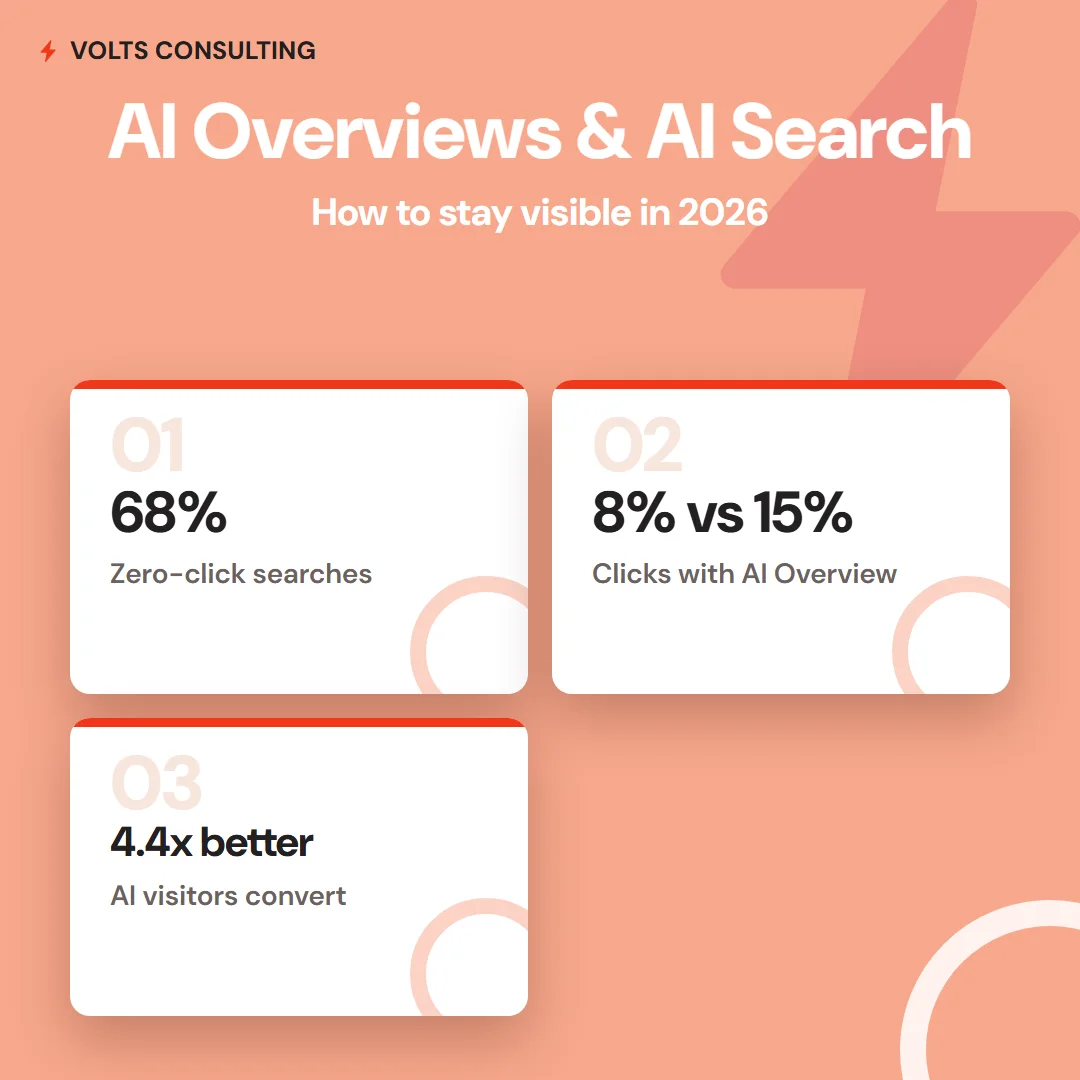
- 68% of US Google searches now end without a click to any website, up from about 60% in 2024 (SparkToro/Similarweb).
- When an AI Overview appears, clicks on regular results drop from 15% to 8% — roughly half (Pew Research, 2025). Only ~1% of users click the AI Overview's own source links.
- AI Overviews started on informational questions, but they're spreading into commercial searches — the informational share of AI Overview triggers fell from 89% to 57% in a single year (Semrush).
So yes: the free traffic firehose is narrowing. If your growth plan is "rank #1 and collect clicks," that plan is aging fast.
Is this all bad news for your business?
No — and this is the part most coverage skips. The answer engines cite sources far beyond the old top three results, which means businesses that never won the blue-link fight can still win mentions. Two numbers worth knowing:
- Only 5–10% of the citations in a typical AI Overview are the brand's own website (McKinsey). The rest is the ecosystem around you — reviews, articles, directories, communities. You can influence that ecosystem starting this week.
- The visitors who do click through from AI answers arrive pre-sold: HubSpot's data puts LLM-referred visitors at 4.4× the conversion rate of ordinary organic visitors. Fewer clicks, better clicks — Adobe measured AI-driven referral traffic to US retail sites growing +693% over the 2025 holidays.
The five moves that actually matter
Everything below is ordered by effort-to-impact for a small or mid-sized business. Do them in order.
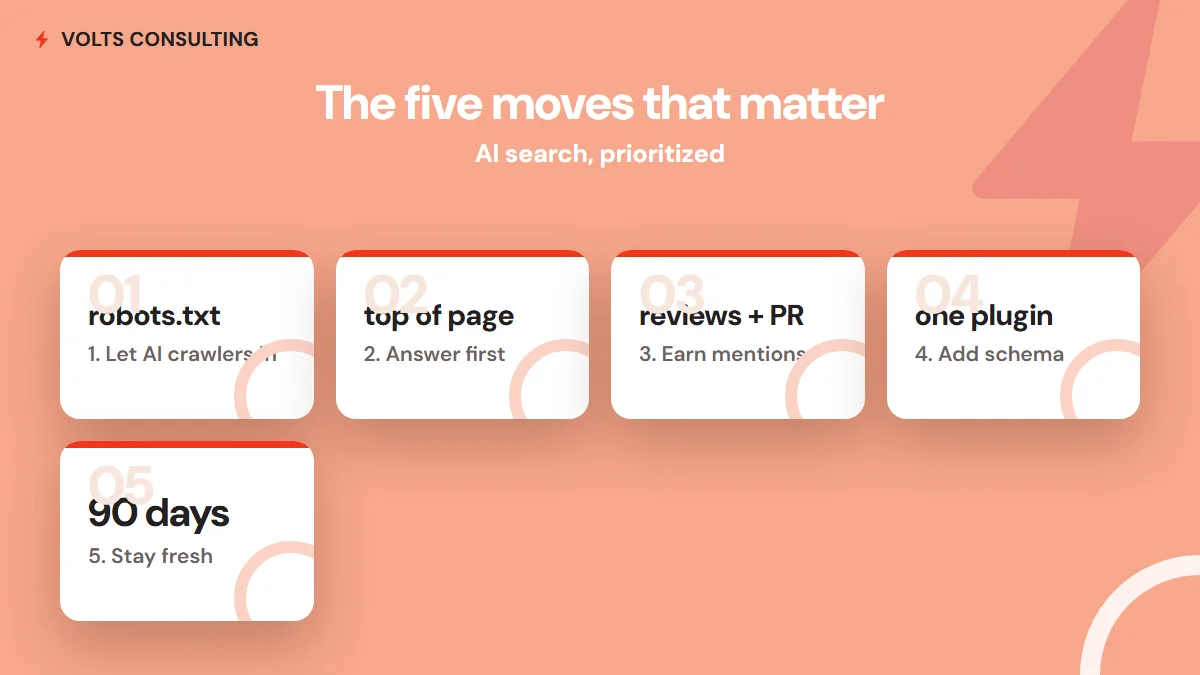
1. Let the AI crawlers in
AI engines can only cite what they can read. Two checks: your robots.txt shouldn't block the AI crawlers (GPTBot and OAI-SearchBot for ChatGPT, PerplexityBot, Google-Extended), and your content must exist as real, server-rendered text — pages that only assemble in the browser, or bury key facts inside images, are invisible to most of these systems. If your site passes the basics of technical SEO, you're most of the way there; Google itself says AI Overviews need "no additional technical requirements" beyond being indexable.
2. Put the answer at the top of the page
AI engines quote the start of things: 44% of ChatGPT citations and 55% of Google AI Overview citations pull from the top 30% of the page. Write like you're answering a customer's text message — direct answer in the first sentence or two, detail afterward. Phrase page headings as the questions customers actually ask, and give each one a two-to-three sentence plain answer before elaborating. This single writing habit does more for AI visibility than any tool you can buy.
3. Get mentioned in the places AI reads
Here's the stat that should reorder your marketing priorities: in Ahrefs' study of 75,000 brands, unlinked brand mentions correlated with AI Overview visibility three times more strongly than backlinks (0.66 vs 0.22). Being talked about now beats being linked to. In practice:
- Reviews first. Domains with review-platform presence earn ~3× more ChatGPT citations (SE Ranking). A complete, active Google Business Profile, plus the review sites your industry actually uses.
- Communities and media second. Reddit is the single most-cited domain in Google's AI Overviews; YouTube and Quora follow. Genuine participation and the occasional expert quote in an industry article go further than another directory listing.
- Consistency everywhere. Same business name, services, and details across your site, profiles, and listings — AI engines cross-check, and inconsistency reads as unreliability.
4. Add structured data — the one-plugin version
Schema markup is a label on your content that machines read: "this is the business, this is the service, these are the FAQs." You don't need to learn it; you need it present. On WordPress a maintained SEO plugin does it; on a custom site it's an afternoon for your developer. Organization and FAQ markup are the highest-value pieces. It won't put you in an AI Overview by itself — it makes everything else easier to parse and attribute.
5. Keep your money pages fresh
Of all the engines, ChatGPT weighs recency hardest (Ahrefs' analysis of 17M+ cited URLs) — and it crawls roughly 8× more often than Google (Conductor). A services page whose prices, examples, and dates are two years stale is exactly the citation an answer engine skips. Put your top pages on a 90-day review cadence: update the facts, refresh the examples, touch the date honestly.
Should you bother with llms.txt?
You'll hear about llms.txt — a proposed file that hands AI engines a map of your site. The honest status in 2026: only ~10% of domains have one, no engine has confirmed it affects citations, and some marketers argue it's not worth the file it's written in. We ship one on our own site anyway — it costs nothing to maintain and mirrors content we already publish — but it's the last item on the list, not the first. Anyone selling llms.txt as the secret to AI visibility is selling the cheapest item on the menu at the highest price.
How do you check whether you're showing up?
No paid tools required:
- Ask ChatGPT, Perplexity, and Google (with AI Overviews on) the five questions your customers actually ask before buying — including "best [your service] in [your area]." Note who gets named and cited; do it monthly.
- In Google Search Console, watch impressions on question-style queries — AI Overview citations count as impressions even when clicks fall.
- Watch branded search volume. When AI assistants recommend you, people search your name to verify — rising branded searches are the earliest signal the mentions are working.
The short version
- Let AI crawlers read your site (robots.txt + real text on the page)
- Answer first, elaborate second, headings as questions
- Stack reviews and earn mentions — they beat backlinks 3:1 in AI search
- Ship Organization + FAQ schema via a plugin or your developer
- Refresh money pages every 90 days
- Skip llms.txt anxiety; check your visibility monthly by asking the engines yourself
None of this replaces classic SEO — rankings still feed the machine that AI answers learn from. It's one discipline now, which is why we fold AI-search visibility into every SEO engagement rather than selling it as a mystery add-on. If you'd like an honest read on where your business stands in AI search, book a free strategy call — we'll run your real customer questions through the engines with you and show you exactly what they see.
Frequently asked questions
Can I opt out of AI Overviews? Technically yes — the same controls that block snippets (nosnippet, noindex) keep you out. But they gut your regular search visibility too, and your competitors stay in the answers. For almost every business, opting out is losing twice.
Is SEO dead now? No — it changed shape. AI engines learn who's credible largely from the same signals good SEO builds: crawlable sites, genuinely helpful content, reviews, mentions, authority. The businesses losing traffic are the ones whose entire strategy was thin content ranking on volume.
Do I need a separate "AI SEO" service? Be skeptical of one. The work overlaps heavily with modern SEO, and the right question for any provider is the same as ever: what, specifically, will you deliver? Some agencies price GEO work as a separate line item — we covered what that costs (and when it's justified) in our SEO pricing guide.
How long before I show up in AI answers? Reviews and mention signals can surface in weeks — ChatGPT recrawls fast. Authority-driven citations build over months, on roughly the same timeline as classic SEO. The five moves above are compounding investments, not switches.